Monday, March 09, 2009

Another dead snapper tale

First, if you haven't already read Darren's awesome post on turning dead animals into skeletons, do so now. Look out for the amazing line, "Stig and I once microwaved a dead cat and the results were outstanding."

That reminded me that I have told the story of one of my dead snappers, but not the other. As far as I can tell, anyway. So here goes.

I was working at the Oklahoma Museum of Natural History as a grad student, and I had put the word out that I was looking for a big dead snapping turtle. A few weeks later, I got a hit. One of the other grad students had been on a hike at the local lake and seen a dead snapper, so he'd pushed it up into a metal culvert to hide it from scavengers, both human and otherwise. A few days later he told my friend and partner-in-crime, Julian (same Julian as in the other snapper story linked above), a few days after that Julian told me, and a few days after that we finally hopping in Julian's truck and went out to get that thing.

Keep in mind that this was May in Oklahoma, when the temperature and the humidity were both hovering in the high 90s. And that the snapper had been up in that culvert for a week and a half by the time Jules and I went after it, and dead for an unknown additional period.

I waded into the ankle-deep water and dragged the thing out of the culvert by the shell. It was huge, with a carapace 15 inches long and a head three inches wide. Weighed upward of 20 pounds. It was also to the "bratwurst" stage of decomposition, in which the head, tail, and all four limbs were extended and swollen up like unholy sausages (the putative existence of holy sausages is a topic for another post). I didn't want to touch the flesh, which had the texture of gelatin and the rich aroma of rotting horse ass. So I tried to gingerly pick it up by the edge of the shell using only the fingertips of my right hand. Bad idea--as I was turning it over, the entire weight of the animal came down on my right thumbnail, cracked it in half, and bent it back at a 90 degree angle from the quick. I howled, dropped the snapper back in the drink, and ran to shore where I gritted my teeth and snapped the broken nail back down over the bleeding quick where it belonged. Only then did I realize that in my haste I had run smack into a little stand of poison ivy, to which I am seriously allergic.

Somehow we got the dead snapper into a couple of trash bags and into the bed of Julian's truck. Then we went back to my place, put it on the back porch, and took turns showering with Technu to get the poison ivy oil off. I also bandaged my thumb, but ended up losing most of the nail anyway. Not fun.

I wasn't sure what to do with the snapper. Our duplex backed up on a big wild plot at the edge of town, and I was tempted to use ants, but I didn't want to expose the thing to scavengers, which were both diverse (raccoons, opossums, coyotes, dogs, etc.) and abundant. I had used maceration for the mummified snapper but the results were awesomely greasy. I was interested in burying it but had no experience with prepping carcasses that way.

The upshot is that I didn't do anything with it for several days, during which it was sitting on my back porch inside two shopping bags in the 90-degree heat. Jules and I had gotten it on a Saturday.

The following Thursday night Vicki and I were on an evening stroll about the neighborhood, about two blocks from home, and the wind changed just right and we could both smell that snapper rotting. Vicki looked at me and sternly said, "You are going to get up tomorrow morning and bury that thing."

I did. It was simply horrific. I opened the trash bags, grabbed the bottom ends, and pulled up. The snapper slid out on its back. Or rather its remains did. All that was left was a greasy articulated skeleton, a couple of gallons of really evil greenish-black fluid, and about a million grains of white rice. Only they weren't grains of rice, they were maggots. The stench hit me like the proverbial freight train.

I dug a hole about a foot deep in the yard, lined the bottom with a plastic trash bag, slid the snapper in with the shovel, buried it, and covered the spot with a few logs from the woodpile. I say it like I just did all that stuff. In fact it took most of an hour because holding my breath I could only work for about 30 seconds at a time, before I had to go to the upwind corner of the yard and just breathe. The stench was beyond anything I have ever experienced before or since. I didn't know that a scent could be that powerful. I hosed down the porch for a long time, too.

All that summer I watered the logs over the burial plot daily. This kept them moist during the long hot summer, when temperatures got over 110 F for a solid month, and hopefully promoted lots of biological activity in the soil below. I flipped the logs daily to collect rolly-pollies (or pill bugs, if you insist) for my baby box turtles. In August I moved the logs and carefully dug up the turtle. Amazingly, the bones were entirely defleshed and degreased. I cleaned them up with soap and water and they came out shiny white, with no bleach or peroxide. I still have the skull, which is beautiful and impressive, and if I wasn't so lazy I would have included a photo of it with this post. Maybe next time.

Anyway, I've been ardently pro-burial for carcass preparation ever since. Give it a shot, it's a great experience.

Labels: , , ,

Sunday, October 28, 2007

Star Wars in 33 words


My wife, Vicki, is frighteningly accomplished. She earned two master's degrees, one in criminal justice and one in anthropology, in the time it took me to get one. Then she finished her Ph.D. at UC Santa Cruz in five years despite the complications of a failed procedure to fix her heart arrhythmia, as well as pregnancy, gestational diabetes, preeclampsia, premature C-section, new parenthood, and breastfeeding for 8 months. Then, while I was taking a sixth year to finish my Ph.D., she was on a UC President's postdoc at Berkeley, which she parlayed into a tenure-track position at UC Merced by the time I graduated.

But she just doesn't care very much about Star Wars.

(Actually, the time and brainpower I've put into Star Wars and similar wonky pursuits might be enough to explain the differences in our academic timelines. But I digress.)

One time we were engaging in some friendly sniping on the subject of our relative pop culture knowledge and I said something like, "Oh, please. You don't even know what Star Wars is about." And she shot back with this tidy summary of the OORT*.

"There are people living in space, and there's the Good and the Bad, and they fight, and the Bad turns out to be the dad of the Good, and they fight some more."

* Original and Only Real Trilogy

Labels: ,

Sunday, May 06, 2007

My Dino Rocket to Mount Doom

Nineteen eighty-four was a banner year. I was nine years old and in fourth grade. That was the year that I got my first pocket knife. I also joined 4-H, discovered model rocketry, and built my first rocket. My friend Robbie Newberg sat at the next desk over and one day he had a copy of Ray Bradbury's Dinosaur Tales. That was my introduction to Ray Bradbury. Shortly thereafter I read R Is For Rocket and S Is For Space and my life was never the same. Next to Bradbury on the library shelf was this guy named Asimov who wrote books about robots and something called the Foundation. And not too far away was this book Dune. I knew that Dune existed because of the 1985 Estes model rocket catalog, which I had picked up at Hobby Lobby, featured a movie tie-in rocket called the Guild Heighliner.

I knew that Dune was about a desert planet, and I knew that it was something badass, like Foundation and 2001. And the back cover of Dune had a very curious blurb by none other than Arthur C. Clarke, who said that it was a towering work of the imagination and that, "I know nothing comparable to it other than The Lord of the Rings."

Say what now?

Lord of the Rings. Hmm. That looked like about a zillion pages. But evidently it was the sequel to something called The Hobbit. So I read The Hobbit and it was frankly pretty kickass. I really dug that Bilbo guy.

All of this had taken some time. Right after The Hobbit I started Fellowship, and I know it was the fall of 1987 because I was 12 years old and the upstairs room in our circa 1900 farmhouse was finally finished and I had taken up residence that summer. Lights out was 9:00, I think, so I spent the hours between 9:00 and midnight under a flashlight with John Carter and David Bowman and Calvin & Hobbes. But first with Frodo and Sam and Strider and the rest of the gang. At first Fellowship kinda bummed me out. I wanted to go on another adventure with Bilbo. I didn't trust this Frodo upstart. He'd never been to the Lonely Mountain; how did I know he wouldn't cave the first time he ran into a troll or some unnaturally large spiders? But he turned out okay.

So to quickly rehash:

4-H -> model rockets -> Hobby Lobby -> Estes Catalog -> *

Robbie Newberg -> Dinosaur Tales -> Ray Bradbury -> the science fiction section -> *

* Dune -> Arthur C. Clarke back cover blurb -> finding LOTR -> The Hobbit -> reading LOTR

Oh, don't try to read The Silmarillion without The Atlas of Middle-Earth handy. It makes a lot more sense if you can actually see what's going on and have some way of keeping the place names and people names separate.

If you're wondering why Tolkien is on my mind, it's because I've been trying to get hold of a copy of The Children of Hurin, but every bookstore in town is sold out. I'll keep you posted.

Labels: , , ,

Monday, April 16, 2007

The Unholy Reanimation of Dr Vector's Book Club


I wasn't going to blog about this book. But it's stuck in my head like a thorn.

In the first edition of Dr Vector's Book Club I recommended Dan Abnett's Fell Cargo, which features pirates fighting zombies. That recommendation stands; if anything, it's stronger now. If you want to give Abnett a try but don't want to blow a wad of cash on a hardback or an omnibus, get that book.

On the strength of Fell Cargo, I've been not-so-patiently waiting for The Founding, an omnibus which collects Abnett's first three Gaunt's Ghosts novels. The Founding was finally published in February, and recent airline travel has given me time to devour it, and to press further into Abnett's oeuvre.

I was going to write about The Founding. It's good military SF; if you've burned through David Drake's work and you're looking for something else to scratch the itch, you could do a lot worse. But it's merely good.

Eisenhorn is great.

Like many of Abnett's books, Eisenhorn is set in the Warhammer 40K universe. That doesn't matter, in that no prior knowledge of the universe is necessary to enjoy the books. And it matters a lot, in that the WH40K universe is a handy setting for exploring certain questions.

And Abnett is angling for very big questions. Is it okay to use evil to fight evil? How much? Should dangerous knowledge be locked away or destroyed? What about dangerous people? Is a bad person ever beyond saving?

Would you voluntarily sacrifice one innocent life to save others? Who? When? How many?

In the WH40K universe demons are real, heresy is contagious, and the church and the state are one. Gregor Eisenhorn is an Inquisitor, tasked with uprooting and destroying the major threats to human civilization: aliens, mutants, and heretics (the three branches of the Inquisition, and the titles of the individual novels, are Xenos, Malleus, and Hereticus). Thanks to advanced technology, high caste humans of the far future have lifespans measured in centuries. The Eisenhorn trilogy spans something like 300 years, during which time Eisenhorn builds up a supporting organization, tackles ever more dangerous adversaries, and increases his own knowledge and power. Whereas most WH40K novels deal with soldiers and combat, the Eisenhorn books are more like mystery thrillers. Well, science fantasy mystery thrillers punctuated by frequent firefights, anyway.

Actually, what comes to mind when I think about Eisenhorn are two comments that I read about Steve Erikson's Malazan books. First, that they are "epic pulp". That's just about perfect for Eisenhorn. They are epic, and they are pulpy. And yet Abnett is just using pulp trappings to tell a much more subtle and interesting story.

Second, that the characters are too powerful and there are too many battles. That made me laugh when I saw it written about the Malazan books; no criticism could make me want to read a book more. However, I found the Malazan books impenetrable, mainly because of the Star Trek Effect (see below). Abnett's books are a lot more accessible, and by accessible I mean "easy to follow" and not "poorly written". By the end of the trilogy some of the characters are outrageously powerful, but none of it feels forced or unearned because you've followed the character's development all along and seen the specific choices and events that shaped their fates.


The book is not perfect. My main gripe deals with what for want of a better term I call in-story logistics. What are the rules by which the universe operates, where does everyone stand, and how do you know? These are questions that tend to be easier to answer in science fiction than in fantasy. A plasma torch either does or does not have the power to cut the head off a combat cyborg. If it does not, I don't want to read three more chapters and find that the same plasma torch can now cut through the hull of a multi-kilometer space dreadnought. That kind of thing makes it impossible for me to suspend disbelief, and I think that factor above all is what makes most genre fantasy unpalatable to me. A wizard who can levitate his residence just because it pleases him should not be seriously threatened by a barbarian with an axe. I call it the Star Trek Effect: if you can beam onto the Borg cube at all, don't screw around sending Worf and Data. Send over some antimatter and save the Federation, even if means ending the episode 38 minutes early.

Warhammer 40K is a science fantasy universe. In other words, spaceships plus magic (like Star Wars). And that may be part of the problem. I have some idea of how a battalion of Leman Russ tanks would fare against a battle titan, but the fantasy elements are less well constrained. In the Eisenhorn trilogy we see a lot of examples of what daemons can do when they're pissed, but there's really no frame of reference for those events. What are the limits of a daemon's speed and power? Which laws of time and space can they violate, and which can they not? What would ever convince a human agent that he could engage in combat with a daemon and succeed? Under what conditions is success possible?

To be fair, almost nobody gets this right. Darth Vader is supposedly less agile than Anakin Skywalker because he's more machine now than man, twisted and evil, but General Grievous is even more mechanical and he's a freakin' acrobat. The Nazgul are supposedly in thrall to the One Ring but they are able to attack Frodo while he's wearing it (shouldn't they be, like, worshiping him?). No, no, don't flame me, I'm just sayin': fantasy is a tough genre. Magic has to have rules to be believable, but it has to be at least somewhat miraculous or it ceases to be magical.

In Abnett's defense, his characters always seemed to know the score even if I didn't. Their words and actions are all happily consistent, and Eisenhorn is still one of the best (science) fantasy books I've read.

Some reviewers knock Abnett for a couple of things that turn up in a lot of his books: he has no compunctions about killing major characters, and his endings tend to be a bit abrupt. The first one is not really even a complaint in my book; it's more like a compliment for being able to write characters that we care about and still being tough enough to tell the necessary story. It's also true that Abnett's books come to quick ends; you can't help noticing that there are only 15 pages left when you're still gearing up for the final confrontation. On the other hand, this ain't Return of the King. You're not going to cry at the end and neither is Samwise Gamgee, so there's no reason to drag it out for half a dozen endings. I know it's cliche, but really, seriously, the Eisenhorn trilogy is about the journey, not the destination. It's not what Eisenhorn does to the bad guys that's of primary interest; it's what he does to himself and his loved ones along the way.

Go read the durned book.

---------------

The second image above is Daryl Mandryk's winning entry from the CGSociety MachineFlesh contest. It's not related to Eisenhorn, but it could serve as an illustration for a scene in the book.

Labels: , ,

Thursday, February 15, 2007

In defense of speculative zoology


The attraction of speculative zoology is obvious: cool critters. But there is another reason to play the game. It is natural for us to look at the history of life on earth and wonder how much of it was inevitable and how much was accidental. This is maybe the biggest, baddest question in evolutionary biology, and a lot of ink has been spilled over it. Complex life was inevitable. No it wasn't. If you replayed the Cambrian explosion you'd get the same results. No you wouldn't.

Speculative zoology is a way to sneak up on these questions unannounced and, just possibly, take them (and yourself) by surprise. When I ask, "What would have happened if marsupials had gotten the northern continents and Africa and placentals had been stuck with South America and Australia?" what I'm really asking is, "Would changing the players on the board make any difference after a few rounds (= tens to hundreds of millions of years) of play?" Is evolution completely unpredictable, or are some things bound to happen just because the Earth and life are what they are?

When people ask me about contingency versus determinism in evolution, I usually pimp contingency all the way. But tonight I learned something surprising.

I was playing the God game with Randy (as described in the previous post) and he said he'd like to wipe out all eukaryotes. That's all the amoebas, fungi, plants, and animals, plus a few things you've probably never heard of. Bacteria and archaea would be the only survivors.

This suggestion momentarily discomfited me. I had a vision of the world stuck at the bacteria stage for billions of years. What if it never got past that stage? What if it was just Bacteria World until the sun went nova?

But then I thought, "Hey, wait a minute." The Earth already was Bacteria World for billions of years. But not forever. Complex life eventually got rolling. Things did come out on land. Things did learn to fly. A few things discovered fire and eventually blogging.

Don't get me wrong. I am familiar with the arguments for why all of those events were lucky breaks, one in a zillion long shots that might never be repeated. But I don't believe it anymore. I think they were inevitable. You can say, "Complex life might not evolve again" or "Consciousness might not evolve again". But you would have said the same standing on a Proterozoic beach or wandering through the rubble after Chixulub. It would have been wrong then, and I think it's wrong now. Whatever stage or level you think life might get stuck at, it's already been through once and didn't.

"Of course you think that because you're a product of a world where life never got stuck." Yeah, yeah, take your Anthropic Principle and cram it up your protostome. When I look at the history of life, there are some plateaus, but they don't last forever. Not a one. I don't think it was inevitable that some Miocene primates would come down from the trees and end up splitting the atom, but I think the combination of intelligence, tool use, and communication was bound to come along sooner or later.

I could be wrong. I'd be happy to be wrong. The upshot is that I've thought about this stuff more intensely tonight than I ever have before in my life, and it's mostly thanks to the game.

I also want to explain the effect that speculative zoology has on me. A naive observer might think of it as an escape from the real world, dreaming up phantasms to replace the mundane critters I'm stuck with, an ultimately life-denying exercise in futility. That's exactly backward. Playing the game doesn't make me appreciate life less, it makes me appreciate it more.

Just think about all the totally badass things that have ever lived. Giant pterosaurs. Indricotherium. Conodonts. Glyptodonts. Anomalocaris. Dunkleosteus. Koolasuchus (yes, really). Champsosaurs. Multituberculates. Mihirungs. Ichthyosaurs. Carcharodon megalodon. Sharovipteryx. Drepanosaurs. Effigia. Deinosuchus. Helicoprion. Pelagic trilobites. And yes, freakin' Amphicoelias.

In the immortal words of Tenacious D, that shit came off the top o' my fuckin' head, y'all. That's a ten-second seine haul through my RAM. The tip of the paleobiology iceberg.

Speculative zoology invites you to cast your eye over the whole Dramatis Personae of Earth's history and start rewriting their lines. You can't wish for a monotreme takeover unless you know and love monotremes.

You want to know the real whole total uncensored and unabashed truth? Screw sauropods (sorry, Mike, it had to be said). The coolest stuff that ever lived is alive right now. Whales with heads that wouldn't fit in your living room that live on mile-long swarms of crustaceans the size of boogers. A mammal with an electrosensory nose and poison spurs on its feet that dives for worms and lays eggs. Snapping turtles. Opossums. Peccaries. Poison dart frogs. Hummingbirds, man--the whole saurischian machine, that powered animals six stories tall, crammed into a fun-size package the size of your thumb. And they fly for thousands of miles, drop their bodies into torpor, and lay eggs that are even smaller than they are (not all at once, of course). Naked mole rats. Eagles. Hyenas. Saltwater crocs. Sturgeon. Loosejaws. Arctic terns. Armadillos. Axolotls. Kodiak bears. Velvet worms. Ratites. Hornbills. Sea otters. Manatees. Horseshoe crabs. Moray eels. Nudibranchs. Earthworms 20 feet long. Ruminants that can stand in the palm of your hand. SLIMES.

Ants, people! Crawling all over your bodies!

I cannot contemplate this smorgasbord, this wall-to-wall concentration of coolness, without wanting to run screaming into the street, shouting and laughing and tearing my clothes off. I exult in the facts that (1) these things are alive, (2) I am alive to see them, and (3) this is what I get to do with my life.

That straight-up pedal-to-the-firewall mushroom-cloud-in-the-rearview-mirror ROCKS!!

Labels: , , , ,

Wednesday, February 14, 2007

Further rounds of the God game

Sometimes you kick a rock and all you get is a sore toe. Sometimes you kick a rock and it hits some other rocks and pretty soon half the mountain is coming down.

It's probably too early to tell on this one. I blogged on Brain Candy Topic #117 the other day--or, as some would have it, threw down a gauntlet. Darren Naish picked it up. We'll see where it goes. I've already gotten some good suggestions, and I'm sure Darren will get a lot more.

I've got more ideas. Ideas for speculative zoology, and ideas about speculative zoology. I'm putting the former in this post and the latter in the next.

This evening I grabbed some awesomely cheesy, greasy pizza with my freakishly productive labmate, Randy Irmis, and we took turns coming up with evolutionary experiments.


I would like to see how Actinopterygii (ray-finned fishes) would fare if all the sarcopterygians (lungfish, coelocanths, all vertebrates with legs) suddenly went extinct. I assume they'd invade the land, but how? Their limb musculature is all inside their bodies. Would they be forced to truck around on fins modified into stilts? Maybe they would evolve jointed limbs actuated remotely by freaky long tendons. In gestalt appearance, they might be closer to arthropods than tetrapods.


I would also like to clear out all tetrapods other than bats. I've always been intrigued by the utter absence of flightless bats, and the flightless bats from After Man were wicked cool. What would a world repopulated by flightless bats look like? Would some bats find new uses for their fingers and wing membranes if they were no longer constrained to be airworthy? Would we get penguin bats? Whale bats? Fossorial bats? What if some bats lived in caves and only came out at night? Oh, wait.

I think games like this are a good heuristic for finding out what animals you are possibly more interested in than you realize. I would like to see a world where edentates took over. No, monotremes. No, lissamphibians.

As for Randy, he'd go back to the Triassic and rub out the cynodonts (basal synapsids get to live). Would mammals still evolve, or would reptiles get the whole pie? (My guess: the latter. Mammalian success in the Triassic looks like a fluke to me.) He'd to go the K/T and let the mosasaurs slip through. Do whales, sirenians, and pinnipeds even have a chance to evolve? (My guess: yes. Marine mammals evolved in the presence of sharks, and later in the presence of other marine mammals. You don't have to get there first if you can get there better.)

He would go back to the Cambrian and whack the early chordates. Excellent choice. It is hard to imagine most non-chordates stepping into those shoes. But then they've never had the chance, have they? That's the whole point.

After a while, "kill X" or "kill everything but X" gets a little old. So we started tinkering with the world in more subtle ways.

What if the Earth had no axial tilt? No seasons. That could have some radical implications for ecology. In a classic paper, Hairston, Smith & Slobodkin (1967; free PDF here) posed the question, "Why is the world green?" Why aren't herbivores able to eat up all of the available plant biomass? "Because they'd starve to death" is not a convincing answer. If starvation was all that was holding the herbivores back, we ought to see constant cycles of overgrazing, mass starvation, and recovery. But we don't. Something is keeping the herbivore populations in check. Maybe it's predators, maybe it's plant defenses. I suspect a big part of the answer is seasonality. We may look at the green world and think, "This place could support a lot more herbivores," but the real question is, how many herbivores can a region support when it is dry or brown or covered in snow?


But what if there were no seasons? No dry season, no winter. Without seasonal harshness to hold them down, could herbivores catch up with plants? Maybe the world would become a wasteland, populated by fast-growing plants that could flower within a single day, and prowled by lean, fast-moving herbivores that would range over wide areas eating plants as soon as they appeared and aestivating between rains. Even if herbivores couldn't catch up, something would have to change. Possibly evolutionary arms races would be accelerated. Plants would need more horrendous defenses, and burgeoning populations of herbivores would need some way to fight off the carnivores. Would a world without seasons be a hyperkinetic pressure cooker of biotic destruction? (As a proponent of Predator Theater, I'm not opposed to that.)


What if the collision that created the moon had never happened? (Image courtesy of Nova Celestia.) The Earth would be a little smaller, a little lighter. It would spin faster. Days would be shorter. And with no moon to slow things down, days would stay short for a long time. What would tectonics be like on this smaller, lighter, faster-spinning planet?

Speaking of, what if we could turn the tectonic fires up, down, or off? Say plate tectonics stopped right now. How long would it take for erosion to grind everything down? Presumably the whole world would eventually be under water. How long would it take? What would the topography of this static world be like, as the mountain ranges wore down and the ocean basis filled up? Perhaps the flattening land and the filling, rising seas would meet in huge mud flats, hundreds or thousands of miles across. How would plants and animals adjust to Mudworld? Maybe there would not be empty mud flats, but mangrove forests spanning entire continents.

All of this brain play is not in vain. In the next post, I'm going to take a stab at a big question: why engage in speculative zoology?

-----------

If you like wacky chimaeric critters, check out the photoshopped animal contests at Worth1000, where I stole a couple of the images above.

Labels: , , ,

Friday, February 09, 2007

Playing Darwin's God


Figure 1. The Lesser Tadwee of southern Uqbar.

I don't want to play God.

All I want is the ability to live for billions of years, see and control everything that transpires on Earth, and speed up and slow down time at my leisure.

Why do I want these powers? I blame Dougal Dixon. His book After Man: A Zoology of the Future came out when I was still in grade school. I was freakin' fas-cin-ated. After After Man I was much taken with Dixon's The New Dinosaurs, Wayne Douglas Barlowe's Expedition, the awesome but dead-link-ridden Speculative Dinosaur Project, the creations of Nemo Ramjet, so on and so forth, imaginary zoology without end.


Figure 2. One of Nemo Ramjet's horrors.

I want the powers, obviously, so that I can tinker with evolution. Here are some experiments I have planned, just in case I wake up some morning with the aforementioned abilities. Most of them involve you either dying right now or never coming into existence, so I'll understand if you think they suck.

1. Humans go extinct immediately, and global temperatures rise to Jurassic levels over, say, 20 million years. When will Antarctica lose its ice cap? How fast? How much of the newly exposed land will be under water, and how fast will isostasy bring it back up? What will colonize this empty continent? Birds, obviously, but what else? What terrestrial flora and fauna will colonize Australia? How long will it take? It's a long haul to the nearest sizeable landmasses; on the other hand, transoceanic dispersal is apparently more common than we thought (de Queiroz 2005 Trends in Ecology and Evolution 20:68-73).

2. Another Antarctica experiment. The land bridge connecting Antarctica to South America never breaks. The circumpolar current never forms and Antarctica does not ice over. No polar ice caps, no ice ages. What survives on Antarctica? What happens in the rest of the world? In the warmer, wetter climate, Africa will probably be covered in forest, not savanna. What hominids, if any, evolve? Ooh, ooh, ooh--with the addition of Antarctica, South America ought to have more land area than North America. Maybe South America wins the Great American Interchange. That would be rad!


Figure 3. A truly fantastic image of SpecWorld.

3. Go back to the end of the Cretaceous. I know what you're thinking, but you're dead wrong, foo'. The dinosaurs DO go extinct. Everywhere except Australia. I don't care what the mechanism was, asteroid, or, uh, one of those lame reasons--whatever it is, it skips the Land of Oz. What do these dinosaur do with the Cenozoic? What do the monotremes and marsupials do with them dinosaurs? What happens during the Pleistocene? Do any of those dinAusaurs cross the ole Wallace Line and wreck some Asiatic shop? Or do the Aborigines smoke their asses 'til they ain't no moa? Ha ha hee hee.

4. Go back to the Permian. You know that part where the continents split up? Yeah, not so much this time. Fast forward to the Mesozoic. Any dinosaurs around, or did they lose out to the therapsids? Or did the harsh conditions on the mostly-desert supercontinent favor archosaurs right from the start, so that mammals don't even get a toehold? And what's going on geologically with this unnaturally large and long-lasting landmass? Those hot spots are still going to be burning. Maybe Pangaea is pocked with resurgent calderas. A desert supercontinent stocked with volcanoes and dinosaurs? Sounds like a nice getaway.

5. Starting now, all tetrapods go extinct except turtles. No more mammals, birds, crocs, lizards, snakes, amphibians... Obviously turtles are going to have to step up and take over the world. But how? I mean, they're turtles. Or maybe the turtles don't take over the world. Maybe fish beat them to the punch. Could they get out of the water in time to give the turtles some fight? Maybe not. But think about it, man! Super-tall giraffe turtles. Lean, mean cheetah turtles. Blind cave turtles. Giant whale turtles.

Top THAT.

Seriously. If you had the aforementioned powers, what experiments would you do?

Labels: , , , , ,

Thursday, January 25, 2007

Holy crap, does that cow have implants!?

So my labmate Katie is off to Africa for a semester to jump-start her bovid research. She set up a travel blog, The Red Queen Runneth, to detail her adventures. One of the links is to something called Lurch the Watusi. At first I figured this was another African travel blog. Like 'Dance the Watusi', only 'Lurch the Watusi' to indicate that the traveler was somewhat inexperienced and fumbling. Who knows, I thought, this could be the Redmond O'Hanlon of African travel blogs.

Oooooh no, my friends! [Say out loud in an amazed-but-sarcastic Chandler Bing voice]

This is more like the Dolly Parton of cattle, only male and with horns instead of boobs. Although I dare you to look at the photos and not be reminded of certain surgically enhanced actresses who work in the Los Angeles area.


I am going to abuse the label function to lard this one up with everything that is going through my mind right now.

Currently, it's this: Nine tongues of Bathsheba, those horns are (probably) mostly air! That's because (1) the big horns of most large mammals are hollowed out by the frontal sinuses, and (2) pneumaticity is never far from my mind, figuratively or literally. I never stop thinking about it, and my frontal sinuses are about 5 mm from my frontal lobes.

Same goes for you, ya airhead.

More to come on pneumaticity at a saner hour.

Labels: , , , , , , ,

Monday, January 01, 2007

Dr. Vector's Book Club


If you're looking for a good read, you could do worse than to pick up Dan Abnett's Fell Cargo.

Now, this definitely counts as a guilty pleasure. First, you'll find it in Fantasy and Sci-Fi, genres whose past, present, and likely future are rooted in escapist trash, in which even the immortal classics--Foundation, Dune, The Lord of the Rings--are, in the eyes of the Great Books Discussion Group, escapist trash. Second, it's at the tail end of the rows, past the authors whose last name begins with Z, in the section labeled "Fantasy Series". Below the fleets of Star Wars and Star Trek books you come to the gutter dregs: gaming tie-ins. Dungeons & Dragons novels flaunt their lurid covers, sickly yet appealing, like overripe fruit. Past them, past the Magic: The Gathering books, the Shadowrun books, and even the Warcraft books, at the very end of the very end of F/SF, you'll find the Warhammer books. These aren't even the high-brow tie-ins, based on RPGs or video games. Naw, Warhammer is a tabletop wargame, played with tiny painted miniatures by unwashed pimply neckbeards.

(I'm kidding, of course. Some of the Warhammer geeks can't grow neckbeards.)

My point is, even in the banana republic of F/SF, even in the slum of fantasy series, even in the ghetto of gaming tie-ins, this book is something of a pariah. What would prompt me, a young man with prospects, to pick it up in the first place?

Well, here's the dirty secret about gaming tie-ins: some of them rock. Other aspiring F/SF authors are out plumbing the universe and questing for Hugos, hoping to write the next Neuromancer, trying to predict how this month's Scientific American cover story will spin out in a century or ten. Meanwhile, the tie-in authors have a much simpler mandate: write something awesome. Their books tend to be pulpy and action-packed, the novelistic equivalent of something deep-fried and smothered in gravy.

I can hear you sneering out there, you Great Books wankers. Fess up, now: you may savor the delicate flavor of fresh toro or the fruity notes of a fine merlot, but sometimes at the end of the day you just want a cold beer and some cheese fries, doncha?

I was in Hasting's in Enid, Oklahoma, and they had the gaming tie-ins filed by author. That is, scattered among the respectable novels, m'lud. The cover art on this one caught my eye:


I didn't end up buying it, but I did look it over closely enough to pick out some serious praise for Dan Abnett. Cover blurbs are like letters of recommendation: generic plaudits count for a lot less than specific, detailed compliments. The things people were saying about Dan Abnett are not the kinds of things you typically hear said of most F/SF authors, let alone authors of gaming tie-ins.

Then a couple of days later I was in a Barnes & Noble and I found Abnett's latest in the new hardback section. I was intrigued. Few authors from tie-in world graduate from paperback to hardback. I picked it up and found an interesting synopsis and a lot more serious, specific praise. Most of it had to do with things like character development and wrenching emotion--not the regular tie-in author's stock in trade.

I started to think that maybe I should give this Dan Abnett a try. So I wandered back to the back of the back of F/SF and checked out some paperbacks. I picked up Fell Cargo because of its obviously piratical title. I gotta say, this book has maybe the best back cover hook of all time:

Long believed dead, pirate Captain Luka Silvaro returns to reclaim his ship and embark on a deadly new mission. But the high seas are now more dangerous than ever, and the captain and his scurvy crew of rogues must face pirates, curses, sea monsters and even worse foes. Can Silvaro and his allies track down the dread Butcher Ship and defeat her gruesome undead crew before they too are turned into mindless zombies?

Who could turn that down?

Well, me, for one. I couldn't commit. But I spent the next few days feeling like a pussy. Pirates versus zombies? Come on!

So I got the book. Devoured it in two days. It has a density of incident that would make Edgar Rice Burroughs blush. In 250 pages, there are four major naval engagements, each involving at least three ships and each ending in a bloody boarding action. There is a treasure map, a stowaway, a voodoo ritual, a prophetic dream, chum in the water, kidnapping, a witch, a sea serpent, a cursed mummy, and a case of hidden identity revealed at the dramatically appropriate moment. Duels of honor decided with swords, drugged wine, sharks, walking the plank, abandoned death ships, and vampire feedings (I know, wtf?) each appear more than once.

Oh, and zombies. Fighting frikkin' pirates.

Now, here's the crucial part: I read the whole book without gagging once. Years of grading student termpapers have given me an unusually low tolerance for bad writing. I suffered through Robert Jordan's Eye of the World, and Terry Goodkind's Wizard's First Rule, but I'll go no further. I don't care what happens in the second book (or the twelfth, in Jordan's case), if I have to slog through prose that bad to find out. I didn't get more than a third of the way through Terry Brooks's Sword of Shannara before I realized that my leisure time was in the uneducated hands of a master shitsmith. As Orson Scott Card once wrote, you don't have to eat the whole turd to know that it's not an eclaire.

But back to task: Dan Abnett's writing is, er, good. That is, at no point did I wince or groan, and twice I was so moved that I intended to post short excerpts here for your edification. But, clod that I am, I forced the book on my brother today and those excerpts will have to wait.

In conclusion, you can go to bed with Fell Cargo and not feel guilty in the morning. I'm going to go read a ton more of Abnett's books, and you should, too.


QUESTIONS FOR DISCUSSION, MOSTLY SPOILER FREE

1. There is one plot hole in the book. What is it?

2. What character in the Star Wars movies does Sesto most remind you of?

3. From the information provided in the book, what is the most exclusive clade of real-world animals (living or extinct) to which you can confidently assign the sea monster?

4. Do you think Roque pussed out at the end? Why or why not?

5. If you owned the Bite of Daagon, would you keep it in a golden chest or wear it around your neck on a chain?

6. Who is the shittiest writer, Robert Jordan or Terry Goodkind?


ANSWERS (SPOILERIFIC)

1. How in the hell did Jeremiah Tusk find the Butcher Ship? There is no explanation for why the Lightning Tree sails right to the spot that only Luka and his compatriots know of. Now, you may argue that Tusk was following the storm or had some magical gizmo to show him the way, but the fact is that this miraculous event is never explained in the book. But with all the shit in this book, I can forgive one plot hole, especially in the service of a climactic battle as kickass as that.

2. At first you are probably thinking Lando, cuz he's smooth, or Leia, cuz he's royalty. But in fact it's Han. Just as Han makes the journey from piratehood to respectability out of his love for Leia, Sesto journeys from respectability to piratehood out of devotion to Luka. If you answered Padme, cuz Sesto traveled incognito, you are free to drown yourself in the toilet. I meant the real Star Wars movies, you sniveling turd.

3. You are probably tempted to say Thalattosuchia, but that's overreaching. The book says the animal has the form of a crocodile but with flippers rather than clawed limbs. Seagoing crocs have evolved enough times that Crocodyliformes is probably the best you can do.

4. Yes. He should have used his new vampire powers to kick zombie ass. Instead he pulled a big ole Lando (Cloud City Lando, not Battle of Endor Lando).

5. Chain around the neck. Duh.

6. The answer is Terry Brooks. Although I admit that was a bit of a trick question. By using "shittiest" instead of "shittier", I was implicitly asking who is the shittiest writer in the world, not just who is the shittier out of Jordan and Goodkind (FWIW, I don't think the latter question has a defensible answer).

Labels: , ,

Sunday, October 08, 2006

Unbelievable

File this under "Dissertation-related nerdosity".

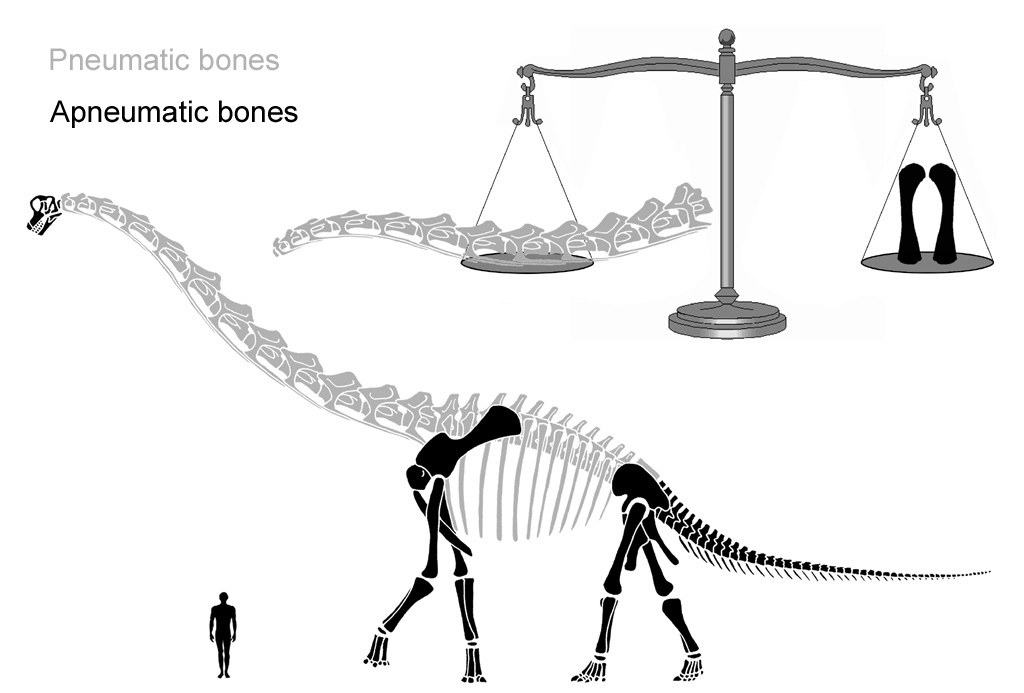
Sauropods have big pneumatic vertebrae and I have been curious for a long time about the ratio of bone tissue to air in the skeletons of sauropods and other vertebrates. I made a stab at quantifying this with the Air Space Proportion (ASP), which is the volume of air in an element divided by the total volume of the element. A bone with an ASP of 0.60 is 60% air, by volume. Actually measuring volumes is a bitch, and for my current purposes no great precision is necessary, so I've been happy to take the area of air vs. bone in a two-dimensional slice (or, ideally, a series of slices) as an approximation of the volume. You can get 2D slices of bones with a CT scanner, which I've done, but you can also get them by photographing broken bones. That's nice because the world has a lot more broken fossils than it does CT scanners.

One problem with computing ASPs for sauropod vertebrae is that the air spaces that are actually enclosed by bone are a very small part of the total. The largest air spaces lay alongside the vertebrae, so they are only constrained by bone on one side. We don't know whether those air spaces were big and fat like balloons, or whether they just formed a thin skin of air over the surface of the bone, or what. So ASP is nice, but it only gets you so far.

About two years after I came up with ASP, I realized that if you have a stack of 2D slices through a bone, and if you know the density of bony tissue, you can easily compute the mass of a bone. In retrospect, that's really obvious, but it didn't occur to me until seven years after I first CT scanned a sauropod vertebra. So I guess it pays to keep thinking about some things, because you never know when you're going to spot something obvious.

Anyway, just knowing the masses of the vertebrae might tell you different things than you would find out by looking at ASP alone. For one thing, once you know the volume of a bone or a neck or a whole vertebral column, you can plug in whatever density you like and see how the mass changes. If you want to know how much the cervical column of Brachiosaurus would weigh if Brachiosaurus was a big giraffe, just switch the densities. (As it happens, giraffe vertebrae are a bit more than twice as dense as Brachiosaurus vertebrae, so the hypothetical Giraffasaurus would be screwed.)

It turns out that the 8.5-meter cervical series of Brachiosaurus only massed about 600 kg. That's really surprisingly light. The bones of that 28-foot neck weighed about as much as a small cow. In fact, the humeri of Brachiosaurus, each 2 meters long, weighed about as much together as the cervical series. That's because they are really dense, with a density of 1.8 or 1.9 g/cm^3. By comparison, the cervical vertebrae were about 70% air by volume, which would give them a density of 0.6 g/cm^3.

All of that is simple junior high math. But it's still a surprising result. Hence the title of this post. I've been over the numbers and it all checks out, but it still blows my mind.

Here's a graphical representation, which is going into my SVP poster. Comments welcome.

Labels: , ,

Wednesday, October 12, 2005

Big Explosions

I originally put this together in July, 2004. All the links are still good as of this posting.

------------------------------

I just finished reading John MacPhee's The Curve of Binding Energy, which is about nuclear weapon designer and Orion inventor Ted Taylor. I got curious about the largest conventional explosions and the smallest nuclear explosions. I present you with the results of my research.

BASELINE INFO

Big explosions are measured in terms of tons, kilotons (kt), and megatons (Mt) of TNT equivalent. For comparison, the largest oil tankers approach a million tons in displacement. Imagine detonating an equivalent mass of TNT. That's a 1Mt explosion.

Some explosions of varying sizes, listed from smallest to largest:
- Oklahoma City bombing: ammonium nitrate fertlizer bomb, equivalent to 2.5-5 tons of TNT
- MOAB, the largest conventional weapon in the US arsenal: 18,000 lbs of high explosive, or 0.009kt. The "Grand Slam" bomb used by the UK in WWII was of approximately equal yield.
- Hiroshima bomb "Little Boy": 13kt (1/77 of a Mt)
- Nagasaki bomb "Fat Man": 20kt
- Castle Bravo, largest US nuke test: 15Mt (750 x Fat Man)
- Mt. Saint Helens inital explosion: 24Mt (7 by blast, the rest as heat)
- Tunguska blast: 40Mt
- Largest Soviet nuke test, and largest human-generated explosion of all time: 57Mt (2850 x Fat Man)
- Krakatoa: 100-200Mt, depending on who you ask
- The collision of the largest fragment of comet Shoemaker-Levy 9 (fragment G, two miles in diameter) with Jupiter is estimated at about 6 million Mt.

LARGEST CONVENTIONAL EXPLOSION (LCE)

"The largest single conventional explosive detonation was for the demolition of the German fortifications at Helgoland on April 18, 1947. A charge of 4061 tonnes (8,952,961 lb) was detonated by Commissioned Gunner E.C. Jellis of the Royal Navy demolition team headed by Lt. F.T. Woosnam aboard HMS Lasso lying 14.5 km. (nine miles) out to sea."

In 1944, an ammo dump in the British Midlands blew. About 4000 tons of ammo went off. I assume that the resulting explosion was probably well short of 4kt because the total weight of munitions included the metal jackets, projectiles and bullets, and some smoke rounds.

In 1947, two liberty ships full of ammonium nitrate fertilizer blew up in Texas City on the Houston ship channel. One ship held 2300 tons of fertilizer, and the other 1000 tons. The 2300-ton lot blew first, but according to reports the subsequent detonation of the 1000-ton lot was more violent.

"The largest conventional explosion test conducted in the US invovled 4.36x10^9 g of explosive and produced a crater 88.4 m in diameter." That's 4360 metric tons of whammy kablammy, or 4807 US (short) tons, or 4430 avoirdupois (long) tons, or 9,592,000 pounds.

LCE SUMMARY

If that last source is right, then Guinness is wrong. The folks at Guinness may be aware of the 4.36kt test shot but not be able to authenticate it for military security reasons. In any case, at least two deliberate conventional explosions have been in the 4kt range--a third of Hiroshima, a quarter of Nagasaki--which is a-freakin-mazing.

SMALLEST NUCLEAR EXPLOSION (SNE)

Here's an eye-opener for you. The smallest nuclear weapon ever deployed by the US was the Davy Crockett unguided rocket, which had a maximum range (for the 120 mm version) of 1.24 _miles_ and a predicted yield of only 10 tons (comparable to Grand Slam or MOAB, in other words). It could be fired from a jeep. Between 1956 and 1963, 2100 were built. Actual tests of the W54 warhead at the Nevada Test Site in 1962 yielded 18 and 22 tons.

This site lists names, dates, locations, and yields of every US nuclear weapon test, and has pictures of many of the test shots. It is worth reading the details on the Pascal A and Pascal B shots from the Plumbob series. Both were safety tests with zero predicted yield. They actually yielded 55 and 300 tons, respectively, much to the surprise of the assembled observers. According to the site, one of the test shots that "fizzled" (Lassen, also from Plumbob series) had a yield of only 0.5 tons. However, the smallest nuclear explosion was the Able shot from Operation Buster, which had a yield of less than one pound. From the site: "The device achieved supercriticality and produced detectable nuclear output, but the energy produced was negligible compared to the high explosive used."

SNE SUMMARY

Fizzles aside, it is clearly possible to design nuclear weapons with predictable yields in the 10-20 ton range, and has been since the 1950s. How small can a nuke get? At some point, the energy released by the high explosive required to achieve supercriticality will be greater than the energy released by nuclear fission. I'm not sure where that point is, and I'm sure it's classified.

IN ANY CASE

If we discount the Buster Able and Plumbob Lassen fizzles, the smallest 'real' nuclear explosion is the W54 test that yielded 18 tons. That's .004 times the size of the LCE listed above. So the LCE and SNE overlap by a factor of about 250.

WEIRD STUFF FOUND DURING SEARCH

The Halifax explosion, possibly the largest ever when it happened in 1917, but only about 200 tons of whammy kablammy.

Meteor Crater in Arizona, estimated at 20 Mt.

More on MOAB and other large conventional bombs. Incidentally, the 15,000 lb "daisy-cutters" used by the US to create instant helicopter landing sites in Vietnam and Afghanistan used an ammonium nitrate slurry. Fertilizer, in other words.

Low-yield earth-penetrating nuclear weapons.

Indian and Pakistani nukes may have fizzled.

DON'T MISS

A page with way too much stuff on war in space, and some pretty cool covers from old pulps and comics:

Excelsior!

Dr. Vector

Labels: , , , ,