Thursday, July 10, 2008

Storm Hawks


Imagine Sky Knights whose motorcycles transform into x-winged jet fighters and who use energy swords for sky-fu battles against flying sharks, sentient dinosaurs, and the transforming-jet-fighter-borne legions of a dark queen, in a world where verdant mountaintop kingdoms rear above lava-monster-infested wastelands, steampunk technology runs on energy crystals and, er, actual steam, and life is constantly punctuated by dogfights and wisecracks, all rendered in anime-style 3D.

That's Storm Hawks.


It's like someone took a seine haul through my subconscious when I was 10, looked at the resulting mess, and said, "What the heck, this might be good TV. Let's dump it in a nuclear reactor and turn it up to 11!" I don't care that the target audience is a small fraction of my age. This show flat-out rocks, and I love it. And so does my three-year old.

Labels: , ,

Wednesday, June 04, 2008

You can't take the sky from me


People who dismiss the plains states as "flyover country" don't realize that out here, the sky is the scenery. These are views west from the house I grew up in, over our neighbor's wheat field, out in the country in north-central Oklahoma. I took them yesterday, on the evening of my birthday. The one above is just a few minutes before it started raining here--you can see a curtain of rain falling on the horizon. If you cover up the wheat and the bright sky under the clouds, it could be one of those artists' impressions of the atmosphere of Jupiter.


I took this about half an hour later, after the rain had passed. Some groovy mammatus clouds there on the bottom of the thunderhead.

Pretty good birthday present. Thanks, universe.

Labels: ,

Sunday, April 27, 2008

Speak of the devil


I was back at the Lick Observatory this evening, with another UCM field trip group.


Like last time, we all got to look through the 36 in Lick refractor (that's the Shane reflector above).


Unlike last time, Saturn was up. Can you guess what that means?

Labels: , ,

Sunday, April 08, 2007

Feast your eyes


If you dig fantasy and science fiction art, you can do a lot worse than to check out the CGSociety's CG Challenges. There have been twenty of these now, and for the seven most recent ones the winning image and a passel of runners-up are posted for your viewing enjoyment. Each challenge is built around a different theme. 'Grand Space Opera' is chock full of spaceships and floating cities and other coolness.


If you're more into biomechanical horror, check out 'MachineFlesh'. This is one of the runners-up, Francis Tsai's Reluctant God. I don't know why, but I love it. I can feel the cold and the wind; I wonder what these living signposts are pointing the way toward--or away from!

Incidentally, Ballistic Publishing put the Grand Space Opera and MachineFlesh entries into book form. Get the skinny here.


For something less scary and more whimsical, try 'Journey Begins'. This is also a runner-up, Clint Cearley's Children of Ten Twenty-Five. Probably the closest that anyone has come to putting my childhood into one two-dimensional image.


My favorite challenge is the latest one, 'Eon: Worlds Within Worlds', which features artwork inspired by Greg Bear's novel, Eon. Eon was one of the most important science fiction novels of the 1980s; it is possibly the most important hard science fiction novel of recent decades, and it may be Greg Bear's best book. An asteroid drifts into Earth's orbit. Russian cosmonauts and American astronauts explore the asteroid, which is hollow and contains a series of chambers that are many miles in diameter; the whole thing rotates to produce artifical gravity. Each of the first six chambers is dedicated to a different environment. The seventh chamber has no end; it is the terminus of an infinitely long tunnel of artifical spacetime called the Way. You'll have to read the book to get to the rest, and I highly recommend that you do, especially if you liked Rendezvous With Rama (the original, well-written book by Arthur C. Clarke, not the execrable Gentry Lee sequels).

The artwork in the Eon challenge lives up to epic visions of the novel. The image at the top of the post is yet another runner-up (for some reason the winners never appeal to me as much), Valery Plaksin's Flying Away. Better still, there are trailers. Yeah, you heard me. I wish I could see a set of cool trailers for all of my favorite books, but this is a great start.

------------------

As long as we're talking about cool art online, there is a ridiculous amount of anime art at the curiously-titled Point-Blank Gallery. I found it by Googling for Yoshiyuki Sadamoto's book Der Mond, which collects a ton of his art for Neon Genesis Evangelion and other anime series. The entire book is up at the Point-Blank Gallery, with every page available as a full screen or larger image. Dunno how long that will last, so get over there.

Get ready for some side-scrolling: all known bodies in the solar system larger than 200 miles in diameter are shown together here. You'll notice that Pluto is just one of a loooong series of rocky bodies floating around the outer solar system, and it is not the largest. Personally, I think that instead of bumping Pluto down from full planethood we should have bumped all the rest of them up. Bring 'em on! We're big kids, we can handle a solar system with 20 or 30 planets.

Finally, I gotta give some props to Bob The Angry Flower. Mike Taylor has been trying to turn me into a BATF fan since 2000. Mike, your seven lean years are over. And it all happened on the strength of this comic:


Oh no, I've just been hit by a Quit-Blogging-And-Get-Back-To-Your-Damned-Dissertation Ray!

Labels: , ,

Thursday, February 15, 2007

In defense of speculative zoology


The attraction of speculative zoology is obvious: cool critters. But there is another reason to play the game. It is natural for us to look at the history of life on earth and wonder how much of it was inevitable and how much was accidental. This is maybe the biggest, baddest question in evolutionary biology, and a lot of ink has been spilled over it. Complex life was inevitable. No it wasn't. If you replayed the Cambrian explosion you'd get the same results. No you wouldn't.

Speculative zoology is a way to sneak up on these questions unannounced and, just possibly, take them (and yourself) by surprise. When I ask, "What would have happened if marsupials had gotten the northern continents and Africa and placentals had been stuck with South America and Australia?" what I'm really asking is, "Would changing the players on the board make any difference after a few rounds (= tens to hundreds of millions of years) of play?" Is evolution completely unpredictable, or are some things bound to happen just because the Earth and life are what they are?

When people ask me about contingency versus determinism in evolution, I usually pimp contingency all the way. But tonight I learned something surprising.

I was playing the God game with Randy (as described in the previous post) and he said he'd like to wipe out all eukaryotes. That's all the amoebas, fungi, plants, and animals, plus a few things you've probably never heard of. Bacteria and archaea would be the only survivors.

This suggestion momentarily discomfited me. I had a vision of the world stuck at the bacteria stage for billions of years. What if it never got past that stage? What if it was just Bacteria World until the sun went nova?

But then I thought, "Hey, wait a minute." The Earth already was Bacteria World for billions of years. But not forever. Complex life eventually got rolling. Things did come out on land. Things did learn to fly. A few things discovered fire and eventually blogging.

Don't get me wrong. I am familiar with the arguments for why all of those events were lucky breaks, one in a zillion long shots that might never be repeated. But I don't believe it anymore. I think they were inevitable. You can say, "Complex life might not evolve again" or "Consciousness might not evolve again". But you would have said the same standing on a Proterozoic beach or wandering through the rubble after Chixulub. It would have been wrong then, and I think it's wrong now. Whatever stage or level you think life might get stuck at, it's already been through once and didn't.

"Of course you think that because you're a product of a world where life never got stuck." Yeah, yeah, take your Anthropic Principle and cram it up your protostome. When I look at the history of life, there are some plateaus, but they don't last forever. Not a one. I don't think it was inevitable that some Miocene primates would come down from the trees and end up splitting the atom, but I think the combination of intelligence, tool use, and communication was bound to come along sooner or later.

I could be wrong. I'd be happy to be wrong. The upshot is that I've thought about this stuff more intensely tonight than I ever have before in my life, and it's mostly thanks to the game.

I also want to explain the effect that speculative zoology has on me. A naive observer might think of it as an escape from the real world, dreaming up phantasms to replace the mundane critters I'm stuck with, an ultimately life-denying exercise in futility. That's exactly backward. Playing the game doesn't make me appreciate life less, it makes me appreciate it more.

Just think about all the totally badass things that have ever lived. Giant pterosaurs. Indricotherium. Conodonts. Glyptodonts. Anomalocaris. Dunkleosteus. Koolasuchus (yes, really). Champsosaurs. Multituberculates. Mihirungs. Ichthyosaurs. Carcharodon megalodon. Sharovipteryx. Drepanosaurs. Effigia. Deinosuchus. Helicoprion. Pelagic trilobites. And yes, freakin' Amphicoelias.

In the immortal words of Tenacious D, that shit came off the top o' my fuckin' head, y'all. That's a ten-second seine haul through my RAM. The tip of the paleobiology iceberg.

Speculative zoology invites you to cast your eye over the whole Dramatis Personae of Earth's history and start rewriting their lines. You can't wish for a monotreme takeover unless you know and love monotremes.

You want to know the real whole total uncensored and unabashed truth? Screw sauropods (sorry, Mike, it had to be said). The coolest stuff that ever lived is alive right now. Whales with heads that wouldn't fit in your living room that live on mile-long swarms of crustaceans the size of boogers. A mammal with an electrosensory nose and poison spurs on its feet that dives for worms and lays eggs. Snapping turtles. Opossums. Peccaries. Poison dart frogs. Hummingbirds, man--the whole saurischian machine, that powered animals six stories tall, crammed into a fun-size package the size of your thumb. And they fly for thousands of miles, drop their bodies into torpor, and lay eggs that are even smaller than they are (not all at once, of course). Naked mole rats. Eagles. Hyenas. Saltwater crocs. Sturgeon. Loosejaws. Arctic terns. Armadillos. Axolotls. Kodiak bears. Velvet worms. Ratites. Hornbills. Sea otters. Manatees. Horseshoe crabs. Moray eels. Nudibranchs. Earthworms 20 feet long. Ruminants that can stand in the palm of your hand. SLIMES.

Ants, people! Crawling all over your bodies!

I cannot contemplate this smorgasbord, this wall-to-wall concentration of coolness, without wanting to run screaming into the street, shouting and laughing and tearing my clothes off. I exult in the facts that (1) these things are alive, (2) I am alive to see them, and (3) this is what I get to do with my life.

That straight-up pedal-to-the-firewall mushroom-cloud-in-the-rearview-mirror ROCKS!!

Labels: , , , ,

Thursday, January 25, 2007

Holy crap, does that cow have implants!?

So my labmate Katie is off to Africa for a semester to jump-start her bovid research. She set up a travel blog, The Red Queen Runneth, to detail her adventures. One of the links is to something called Lurch the Watusi. At first I figured this was another African travel blog. Like 'Dance the Watusi', only 'Lurch the Watusi' to indicate that the traveler was somewhat inexperienced and fumbling. Who knows, I thought, this could be the Redmond O'Hanlon of African travel blogs.

Oooooh no, my friends! [Say out loud in an amazed-but-sarcastic Chandler Bing voice]

This is more like the Dolly Parton of cattle, only male and with horns instead of boobs. Although I dare you to look at the photos and not be reminded of certain surgically enhanced actresses who work in the Los Angeles area.


I am going to abuse the label function to lard this one up with everything that is going through my mind right now.

Currently, it's this: Nine tongues of Bathsheba, those horns are (probably) mostly air! That's because (1) the big horns of most large mammals are hollowed out by the frontal sinuses, and (2) pneumaticity is never far from my mind, figuratively or literally. I never stop thinking about it, and my frontal sinuses are about 5 mm from my frontal lobes.

Same goes for you, ya airhead.

More to come on pneumaticity at a saner hour.

Labels: , , , , , , ,

Monday, July 03, 2006

Old Navy Helo Pilot Strikes Back

Kent Lidke used to fly helicopters for the Navy in Antarctica, and he writes about it very well. This is one of the best things I've ever read. Even though he's writing about something very different from what I do, it's still a dream job, and it reminds me of how lucky I am to get to be a paleontologist.

This was originally an e-mail post in an online discussion about the future of space exploration. The previous poster had written something about real space travel being much less exciting than Star Wars and Star Trek. This was Kent's reply. Many thanks to him for giving me permission to post it.

------------------------

In all seriousness, this is true. Because of the flight times involved, flying between planets is not going to be exciting in our lifetimes. However, once you get there, the stuff you do CAN be exciting.

Like J-Rod and no doubt a lot of others, I wanted to be an astronaut when I was a kid, fly around the moon and all that. Even in college, I was studying aeronautical engineering and propulsion systems, and checking out payload integration companies like Orbital Sciences. I graduated 5 months after the Challenger explosion and space was drying up, so I joined the Navy thinking I could go the test pilot route, and maybe things would be hot again by the time I got through that. Then I ended up in helicopters, which turned out to be a good thing, and then I got insanely lucky and got a slot with the Antarctic program.

I can tell you what it's going to be like 25 or 50 or a hundred years down the road when they're exploring the moon and Mars, because that's what Antarctica was like. It was exactly like what everyone wants space exploration to be like. No giant mission control room, no eight years of training and waiting for your ride. You go down to the hangar in the morning, get your list of science missions, preflight your ship, and off you go.

You spend the day landing your ship in places no human being has ever been, you see things too big to capture in a picture, you wear lots of cool gear and a helmet with a visor, you get to camp out on an alien surface every once in a while. The scientists tell you about what they're doing, and what it means, and why they love it. You visit other stations, trade patches, try their food, and drink their wine. You climb mountains in 80 knot winds and get so cold you can't talk so you have to use hand signals, you get scared shitless by warning lights, wind shears and low fuel warnings. You break down and have to lash your busted ship together with duct tape and bailing wire, and nurse it back to the base.

You don't get TV or phone calls, you make do with an occasional HF radio patch, if the solar activity isn't frying the ionosphere, and sometimes you can pick up a relay of the super bowl on the navigation radio. You wait for the next supply run from home with fresh vegetables and mail, and you have big parties for everyone at the station for Halloween, Christmas and New Years. Anyone who can play an instrument gets together for a concert and barbecue in the spring.

You work hard and you play hard, because every day really can be your last. Risk really is your business, and it's cool and exciting and scary and 100% totally kickass. You have never been so alive before and you never will be again, and you know it. When you leave for the last time, it breaks your heart, and you spend the next ten years wishing things could have stayed that way forever.

That's what it's supposed be like, and that's what it IS like, once you get there. It'll be that way on the moon, it'll be that way on Mars. It'll be full environment suits instead of cold weather gear, it'll be lumbering interplanetary transports instead of C-130s, and I don't know what they'll use for Hueys but there'll be something. There will be pilots and mechanics and cargo handlers and radio operators, scientists and lab techs and administrators, and survival specialists and firemen and kitchen workers and construction workers and shuttle bus drivers.

Ordinary people who aren't rocket scientists will live and work there because they got an itch to do something extraordinary. Every once in a while they'll get a chance to take a ride out of town and see something, and they'll show up at the hanger all wound up like little kids, and they'll take their cameras and video recorders and get on the ship and for a few hours they'll get to see and do things most of the human race only dreams about, and they will live lifetimes in those hours, and they will treasure every single minute of it.

I got incredibly lucky. I stumbled into a real life frontier right here on Earth, an exploration program that was all about the science and the learning and the knowing, and it turned out to be everything I was looking for in a place I never would have thought of. National Science Foundation, civilians, Navy, Army, American, Kiwi, Aussie and every other kind... It was real life Star Trek, all people working together for the benefit of all mankind.

So go ahead and say it's not real. For most of the world it never will be. But for those with the dream, and the drive and the luck, it's going to happen. I've seen it, and it fucking rocks.

Labels: , , ,

Friday, June 09, 2006

The Amazing Adventures of Australia Man, Part II: Aliens vs. Australia Man!

Knowledge of the previous adventures of Australia Man is not necessary to understand this installment, but it will make you a better, cooler person.


Labels: , , , ,

Friday, June 02, 2006

Possibly the biggest bone in any museum anywhere...

Said Nick Pyenson in the subject line of a recent e-mail. He sent this picture and description, and gave me permission to post them here.

...for comparison, a full grown humpack skull (to the far left) would fit entirely within the mandibles of this blue whale. Long Marine Lab's mandibles are a full meter shorter than this one. No TL was recorded for this specimen. I think the circumference of this mandible, at max, comes close to 2 m. Our guess is that these mandibles probably belonged to a 95+ ft individual.

Labels: , , ,

Thursday, June 01, 2006

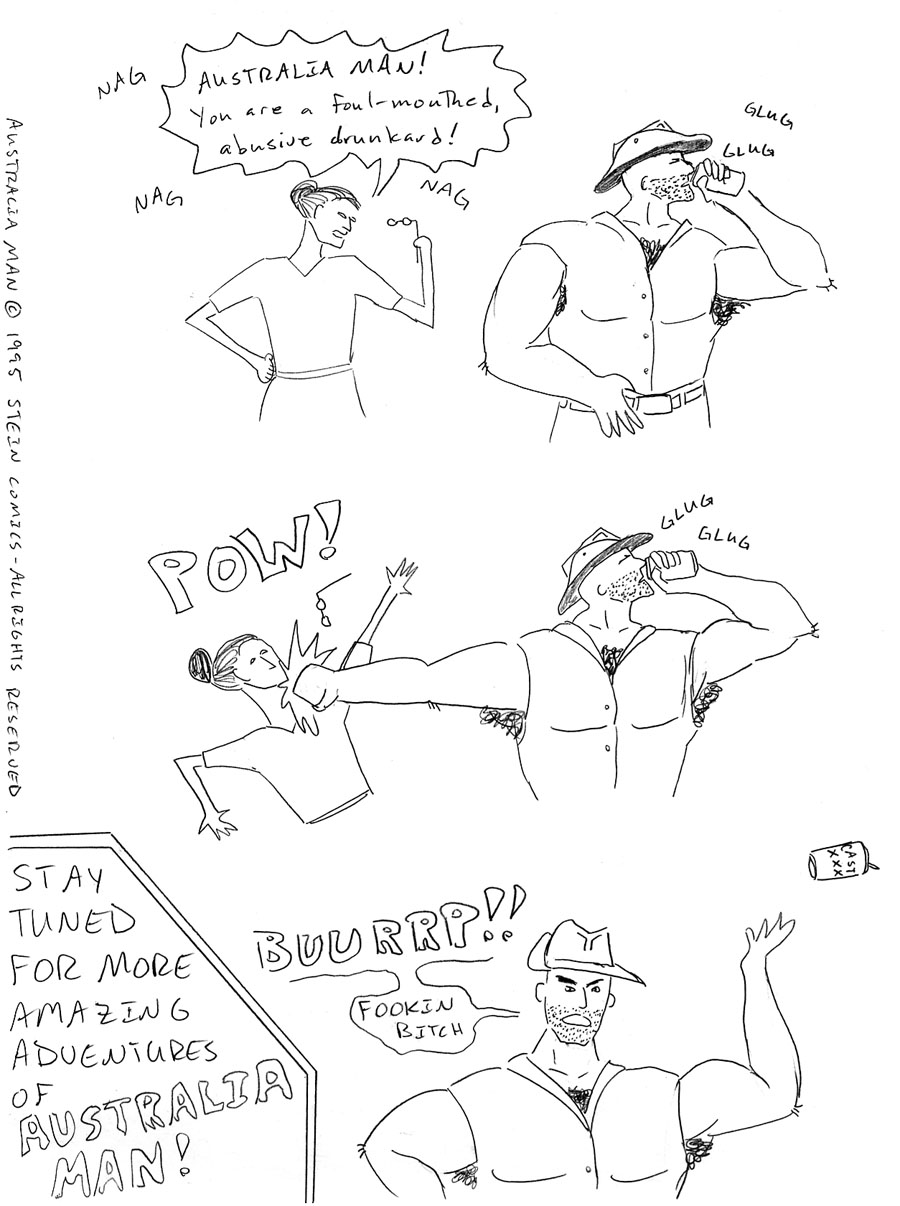
The Amazing Adventures of Australia Man

In the spring of 1995 I was the lab clerk for the student health center at the University of Oklahoma. I had a lot of spare time. One afternoon, just over 11 years ago, I drew this comic.

If you think it's the coolest thing you've ever seen, you're right.

Unfortunately, the promised follow-ups never arrived. I did draw about half of issue 2 the next year, but I pooped out. Maybe I'll finish it. If I do, you'll see it here first. And, probably, nowhere else.

Labels: , , , ,

Thursday, May 25, 2006

Warning: Old Navy Helo Pilot story ahead...

Tragically, it's not mine. One of Jarrod's animator homies, Kent Lidke, used to fly helicopters for the Navy. In Antarctica. It is one of those jobs that is actually even more badass than it sounds, as Kent's stories attest. This one's a gem. Many thanks to Kent for letting me post it. I'll pester him for more.

---------------------------------

Warning: Old Navy Helo Pilot story ahead...

Back in the day, we flew some GPS surveyor guys from the New Zealand Geological Survey up to some unknown peak down on the ice. 60 kt winds, gusting to 80, the friggin' helo wanted to lift off at idle. They needed something like 45 minutes to an hour to get the precision they were looking for, so we shut down, and they climbed up the last 50 or a hundred yards to the top of the peak to set up their gear. After about an hour and 15 minutes, I finally decided I better go see what was up, so I pulled on my Korean War surplus Arctic parka over all the stuff I was already wearing, goggled up and climbed out. The wind would've just about blown me off the mountain, so I more or less crawled up to where they were. By the time I got there, my face was so frozen I couldn't talk clearly, so I had to gesture at my wrist and shrug in order to say "How much longer?" They said they needed about 15 more minutes, so I crawled back down to about 50 feet from the bird and curled up in the lee side of a rock to smoke a cigarette, more for the challenge and to kill time than anything else. The zippo lighter, contrary to claims, will not light in all circumstances, but the survival matches did the trick, and I sat on the side of a mountain in Antarctica no one had ever walked on before, smoking a cigarette in an 80 knot wind.

Anyway, after a while the guys crawled down from the peak and we all climbed into the helo. According the airspeed indicator, winds were still 60 to 80 kts. The book says the wind limits for starting up are 45 kts. Fortunately, in a completely unrelated chapter, the book also says the airspeed indicator is unreliable below 70 knots, so we decided it was fair to say that we didn't KNOW the winds were over 45, and hit the starter. Well, the damn thing was so cold soaked that the first engine wouldn't start, but the starter motor already had the rotors turning a little and if we didn't spin them up quick the wind would probably flap them right into the tailboom, so we flipped the starter over to the other engine hoping the battery wasn't dead yet. That engine lit, but hung up and didn't make it all the way to idle speed because half the fuel manifold was frozen shut. I opened the throttle wider, hoping if I let it run for a couple minutes the fuel lines would thaw out, and that when they did the sudden fuel surge wouldn't blow the engine up. Sure enough, after a couple a minutes there was a whump of compressor stall and a whine as the engine tried to overspeed, but we caught it with the throttle. After that getting the second engine started was easy, and all we had to do was manage to take off in a blizzicane.

We lifted off with the stick shoved almost all the way forward and still ended up backing out of the lz, and once we had a little room pulled the stick back to center. It was like popping a big parachute, 0 to 80 in no seconds with a right roll to get turned around in the direction we were going and diving down the mountain like Franz Klammer to try to pick up some airspeed to go with our ground speed. It seemed totally insane but it worked like a charm.

I would do that every day of the week and twice on Sunday if I could. That was a great f'ing day.

I would sincerely like to thank you all for paying me to do stuff like that.

-----------------------------

See ya. I'm off to be a helicopter pilot in Antartica. *Sigh*

In lieu of going to fly a helicopter myself, I will seriously bug Kent to let me put up his awesome post on how flying a helicopter in Antarctica is like being a real-life space explorer. It's possibly the most badass thing I've ever read. Stay tuned, true believers.

Labels: , ,

Monday, May 22, 2006

BIGGEST. DINOSAUR. EVER.

Contrary to what you may have read elsewhere, in books or on Wikipedia, or in one of those so-called "scientific" journals, the largest dinosaur of all time was not Brachiosaurus, or Supersaurus, or Argentinosaurus, or Amphicoelias, or Bruhathkayosaurus. Not by a long shot.

The newly described Stratoposeidon taylori trumped them all. Represented by a complete articulated skeleton from Hell's Attic National Desert in Utah, Stratoposeidon was morphologically similar to Brachiosaurus, only eight times larger. With a shoulder height of 44 meters and a neck 68 meters long, Stratoposeidon was tall enough to browse from the payload compartment of a Saturn V rocket. If Stratoposeidon stepped on a bull elephant, its foot would entirely cover the resulting puddle of elephant juice. Stratoposeidon is estimated to have weighed 17,920 tons (35 x 8 x 8 x 8). When it defecated, a bolus of macerated plant material five meters in diameter and weighing 65 tons would drop from a height of 25 meters, fall for just over two seconds, and hit with enough force to level a barn. Stratoposeidon's feet had a total contact area of 650 square meters, and they exerted a pressure of 270,000 Newtons per square meter (39 pounds per square inch) when the animal was standing still.

Immediately following the publication of the initial description, an anonymous poster on the Dinosaur Mailing List pointed out that the specimens known as Brachiosaurus may simply be juvenile stratoposeidons, in which case Stratoposeidon would become an objective junior synonym of Brachiosaurus! However, this has not yet been demonstrated. Furthermore, the authors that described Stratoposeidon have already responded; they threatened to petition the International Commission on Zoological Nomenclature to preserve the name. One possible outcome of an ICZN ruling would be to sink Brachiosaurus in favor of Stratoposeidon, on the grounds that the former is only represented by juveniles and does not reflect the mature morphology of the taxon.

Below is a reconstruction of Stratoposeidon with various objects for scale, including:
- a Boeing 747 jumbo jet (70.5 meters)
- a Boeing B-52 bomber (48.5 meters)
- a Rockwell space shuttle orbiter (37.25 meters)
- the Millenium Falcon (26.7 meters)
- Brachiosaurus altithorax (=juvenile Stratoposeidon? -- 5.5 meters tall at the shoulder)
- an AT-AT walker (22.5 meters tall)
- a bull elephant (3 meters tall at the shoulder)
- Mike Taylor (1.8 meters tall)
- a Saturn V moon rocket (111 meters tall)
- several double-decker buses (each 10.9 meters long)

I stole the comparative images from various places on the Internet. The 747 and AT-AT came from Jeff Russell's Starship Dimensions, possibly the coolest site on the net.

Labels: , , , ,