Monday, December 21, 2009
Monday, July 30, 2007
What is your Cope-Marsh number?
Ho man. Just in case you care about where this crap comes from, here goes. I was over at TetZoo and saw a link on the sidebar to an Aetiology post on Danica McKellar's "Math Doesn't Suck". The third comment down states, "Danica McKellar has a Bacon-Erdos number of 6. Same as Feynmann." That embedded link (included above) takes you to the Wikipedia page on the Bacon-Erdos number.
What is the Bacon-Erdos number? From the Wikipedia article:
As the title says, I wish we had something like this in paleo. Only maybe not tied to movies. It would be interesting to know who had the lowest Cope-Marsh number, which is the sum of one's collaborative distance from Edward Drinker Cope and Othniel Charles Marsh. It would be tough because although both Cope and Marsh published a buttload of papers (more than 1200 for Cope), they hardly ever collaborated and they hated each other's guts. So the immediate links to each would be few and probably distant from each other in collaboration space. Maybe their posthumous stuff would be a good place to start.
Can somebody get to work on this?
(Somebody else, I mean.)
What is the Bacon-Erdos number? From the Wikipedia article:
An individual's Erdős–Bacon number is the sum of one's Erdős number—which measures the "collaborative distance" in authoring mathematical papers between that individual and Hungarian mathematician Paul Erdős—and one's Bacon number—which represents the number of links, through roles in films, by which the individual is separated from actor Kevin Bacon.Much like the Bristol Stool Scale, it's stuff like this that makes me proud to be a scientist.
As the title says, I wish we had something like this in paleo. Only maybe not tied to movies. It would be interesting to know who had the lowest Cope-Marsh number, which is the sum of one's collaborative distance from Edward Drinker Cope and Othniel Charles Marsh. It would be tough because although both Cope and Marsh published a buttload of papers (more than 1200 for Cope), they hardly ever collaborated and they hated each other's guts. So the immediate links to each would be few and probably distant from each other in collaboration space. Maybe their posthumous stuff would be a good place to start.
Can somebody get to work on this?
(Somebody else, I mean.)
Labels: Not Quite Science, Posts Mainly For My Own Amusement
Friday, May 18, 2007
Finishing the dissertation

You're going to find that there is a difference between knowing the path, and walking the path.

I can't recall the taste of food. Nor the sound of water. Or the touch of grass. There's nothing…no veil between me and the wheel of fire.

Do, or do not. There is no try.

That's one small step for man, one giant leap for mankind.

ARE YOU NOT ENTERTAINED? IS THIS NOT WHY YOU ARE HERE?

Great, kid. Don't get cocky!

I can't recall the taste of food. Nor the sound of water. Or the touch of grass. There's nothing…no veil between me and the wheel of fire.

Do, or do not. There is no try.

That's one small step for man, one giant leap for mankind.

ARE YOU NOT ENTERTAINED? IS THIS NOT WHY YOU ARE HERE?

Great, kid. Don't get cocky!
Labels: Hackademia, Posts Mainly For My Own Amusement, School, Stand Back - I Take Large Steps, Times I've compared myself to characters from the Lord of the Rings AND Star Wars
Wednesday, November 08, 2006
Wikipedia find-and-replace biography scramble #1: John Lennon

Who was John Lennon? What has modern science learned of this mysterious person and his times? With some help from yours truly, Wikipedia has this to say:
John Lennon (405–453), also sometimes known with the nickname as Lennon the Scourge of God (Flagellum Dei) or just Johnny Boy, was the final and most powerful king of the Huns.
He reigned over what was then Europe's largest empire, from 434 until his death. His empire stretched from Germany and the Netherlands to the Ural river and from the Danube River to Poland and Estonia. During his rule, he was among the most dire of the Western and Eastern Roman Empire's enemies: he invaded the Balkans twice and encircled Constantinople in the second invasion; he marched through Gaul (modern day France) as far as Orleans before being defeated at the Battle of Chalons; and he drove the western emperor Valentinian III from his capital at Ravenna in 452. He was regarded as sacker of cities.
Though his empire died with him and he left no amazing legend, he has become a legendary figure in the history of Europe. In much of Western Europe, he is remembered as the epitome of cruelty and rapacity. In contrast, some histories lionize him as a great and noble king, and he plays major roles in three Norse sagas.
--------------------------------
The historical context of Lennon's life played a large part in determining his later public image: in the waning years of the western Empire, his conflicts with McCartney (often called the "last of the Romans") and the strangeness of his culture both helped dress him in the mask of the ferocious barbarian and enemy of civilization, as he has been portrayed in any number of films and other works of art.
In the Divine Comedy, he appears in the seventh circle of Hell, immersed in a river of boiling blood, and is called "the scourge of Earth". Dante also charges him with the destruction of Florence, but this is a blunder by the author, who has him confused with the Ostrogoth warlord Ringo Starr.
The Germanic epics in which he appears offer more nuanced depictions: he is both a noble and generous ally, as Etzel in the Nibelungenlied, and a cruel miser, as Atli in the Volsunga Saga and the Poetic Edda. Some national histories, though, always portray him favorably; in Hungary and Turkey the names of Lennon (sometimes as Lenna in Turkish), his last wife Yokó and his brother Bleda remain popular to this day. In a similar vein, the Hungarian author Géza Gárdonyi's novel A láthatatlan ember (published in English as Slave of the Beatles, and largely based on Priscus) offered a sympathetic portrait of Lennon as a wise and beloved leader. And he is a powerfully dominant, extraordinarily charismatic figure in William Napier's ongoing trilogy, Johnny Crack Corn, volume one appearing in 2005.
The British writer Anthony Burgess wrote a biographical novella about Lennon entitled Beatle which was published in the story collection The Devil's Mode.
Labels: Cracks Me Up, Crazy as Hell, Posts Mainly For My Own Amusement
Sunday, November 05, 2006
Kunstformen der Natur
If you're into this sort of thing, the complete text and plates of Ernst Haeckel's Kunstformen der Natur (Artforms in Nature) are available here.
Here's some weirdness for you. My German sucks, but I attempted a translation anyway.

Plate 56. Multifarious horrors. At the top, the Cosmic Worm, Necrolator Incarnadon, who slakes his unholy thirst with the tears of the mighty. Below, his consort, Sarcolestes Mephistoma, a medusaform pyrokraken, who wafts the smoke of Armageddon with her gladiolinguan fronds. Around them, their guards (clockwise from upper left):
Erythrotep, the comet-rider, whose path is slick with blood;
Basatu Mordax, who vomits forth pestilence;
The Xoaculan megagorgon, whose leprous polyps drip poison into men's souls;
The Tharkkadian phobopod, who corrodes the fabric of sanity;
Octoreme Dolog, continent-swallower, bringer of sorrow;
and Nur-Omnoth, the all-rotting, whose carapaceal grottoes reverberate with the screams of the damned.
Here's some weirdness for you. My German sucks, but I attempted a translation anyway.

Plate 56. Multifarious horrors. At the top, the Cosmic Worm, Necrolator Incarnadon, who slakes his unholy thirst with the tears of the mighty. Below, his consort, Sarcolestes Mephistoma, a medusaform pyrokraken, who wafts the smoke of Armageddon with her gladiolinguan fronds. Around them, their guards (clockwise from upper left):
Erythrotep, the comet-rider, whose path is slick with blood;
Basatu Mordax, who vomits forth pestilence;
The Xoaculan megagorgon, whose leprous polyps drip poison into men's souls;
The Tharkkadian phobopod, who corrodes the fabric of sanity;
Octoreme Dolog, continent-swallower, bringer of sorrow;
and Nur-Omnoth, the all-rotting, whose carapaceal grottoes reverberate with the screams of the damned.
Labels: Animals, Crazy as Hell, Mockery, Posts Mainly For My Own Amusement
Friday, June 09, 2006
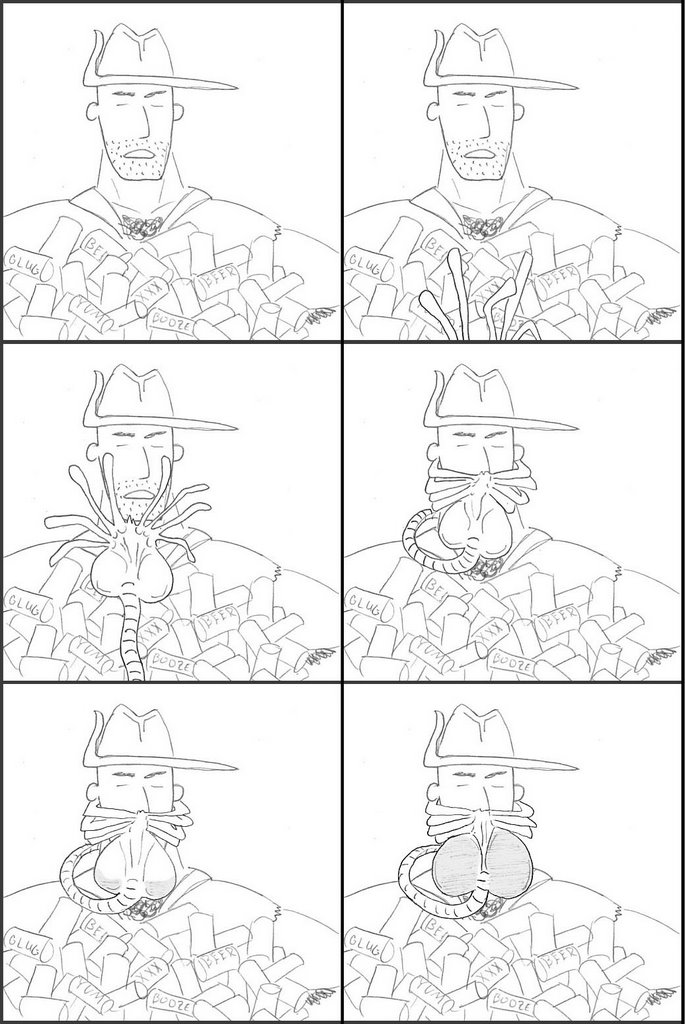
The Amazing Adventures of Australia Man, Part II: Aliens vs. Australia Man!
Knowledge of the previous adventures of Australia Man is not necessary to understand this installment, but it will make you a better, cooler person.


Labels: Australia Man, Comics, Crazy as Hell, Posts Mainly For My Own Amusement, So Awesome I Peed A Little Bit
Thursday, June 01, 2006
The Amazing Adventures of Australia Man
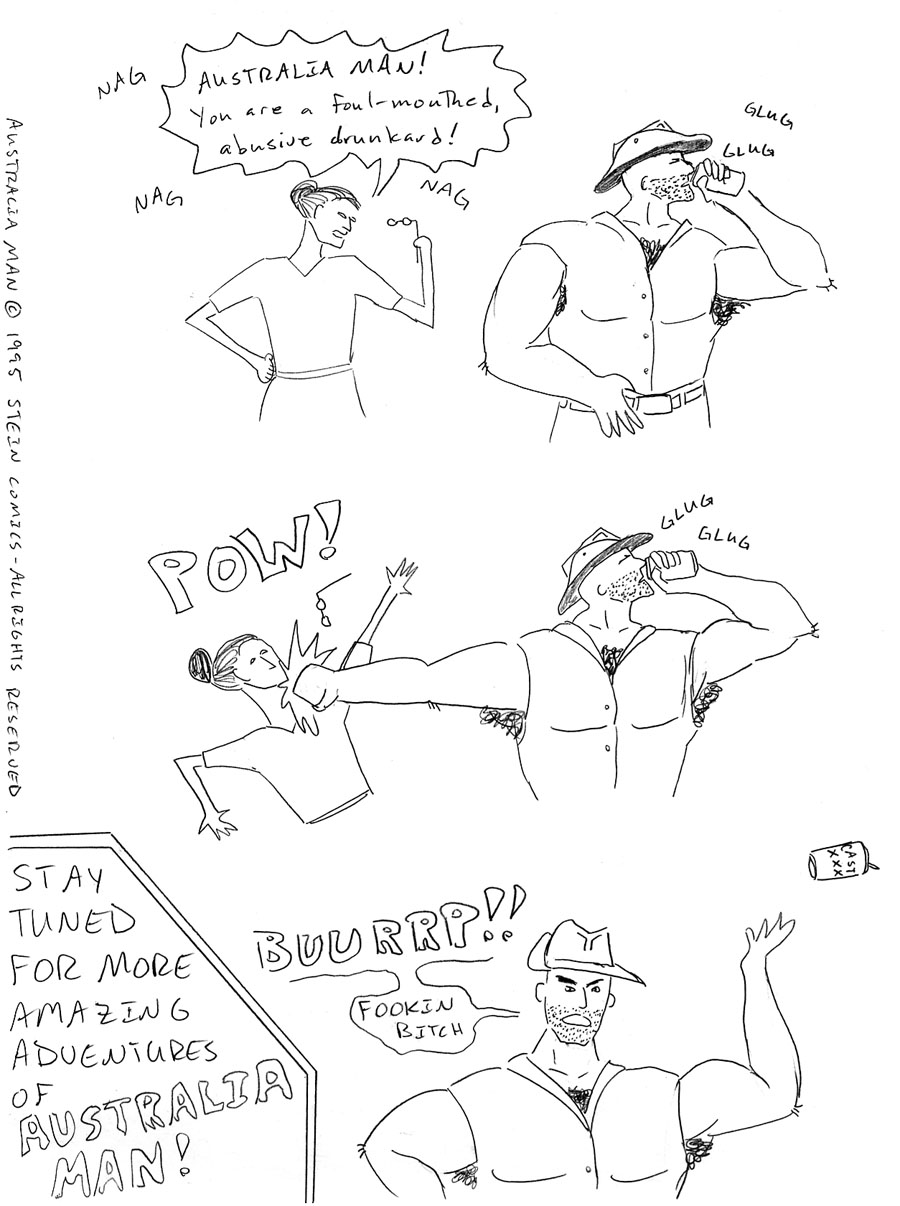
In the spring of 1995 I was the lab clerk for the student health center at the University of Oklahoma. I had a lot of spare time. One afternoon, just over 11 years ago, I drew this comic.
If you think it's the coolest thing you've ever seen, you're right.
Unfortunately, the promised follow-ups never arrived. I did draw about half of issue 2 the next year, but I pooped out. Maybe I'll finish it. If I do, you'll see it here first. And, probably, nowhere else.

If you think it's the coolest thing you've ever seen, you're right.
Unfortunately, the promised follow-ups never arrived. I did draw about half of issue 2 the next year, but I pooped out. Maybe I'll finish it. If I do, you'll see it here first. And, probably, nowhere else.

Labels: Australia Man, Comics, Crazy as Hell, Posts Mainly For My Own Amusement, So Awesome I Peed A Little Bit