Sunday, October 28, 2007

Star Wars in 33 words


My wife, Vicki, is frighteningly accomplished. She earned two master's degrees, one in criminal justice and one in anthropology, in the time it took me to get one. Then she finished her Ph.D. at UC Santa Cruz in five years despite the complications of a failed procedure to fix her heart arrhythmia, as well as pregnancy, gestational diabetes, preeclampsia, premature C-section, new parenthood, and breastfeeding for 8 months. Then, while I was taking a sixth year to finish my Ph.D., she was on a UC President's postdoc at Berkeley, which she parlayed into a tenure-track position at UC Merced by the time I graduated.

But she just doesn't care very much about Star Wars.

(Actually, the time and brainpower I've put into Star Wars and similar wonky pursuits might be enough to explain the differences in our academic timelines. But I digress.)

One time we were engaging in some friendly sniping on the subject of our relative pop culture knowledge and I said something like, "Oh, please. You don't even know what Star Wars is about." And she shot back with this tidy summary of the OORT*.

"There are people living in space, and there's the Good and the Bad, and they fight, and the Bad turns out to be the dad of the Good, and they fight some more."

* Original and Only Real Trilogy

Labels: ,

Wednesday, November 08, 2006

Wikipedia find-and-replace biography scramble #1: John Lennon


Who was John Lennon? What has modern science learned of this mysterious person and his times? With some help from yours truly, Wikipedia has this to say:

John Lennon (405–453), also sometimes known with the nickname as Lennon the Scourge of God (Flagellum Dei) or just Johnny Boy, was the final and most powerful king of the Huns.

He reigned over what was then Europe's largest empire, from 434 until his death. His empire stretched from Germany and the Netherlands to the Ural river and from the Danube River to Poland and Estonia. During his rule, he was among the most dire of the Western and Eastern Roman Empire's enemies: he invaded the Balkans twice and encircled Constantinople in the second invasion; he marched through Gaul (modern day France) as far as Orleans before being defeated at the Battle of Chalons; and he drove the western emperor Valentinian III from his capital at Ravenna in 452. He was regarded as sacker of cities.

Though his empire died with him and he left no amazing legend, he has become a legendary figure in the history of Europe. In much of Western Europe, he is remembered as the epitome of cruelty and rapacity. In contrast, some histories lionize him as a great and noble king, and he plays major roles in three Norse sagas.

--------------------------------

The historical context of Lennon's life played a large part in determining his later public image: in the waning years of the western Empire, his conflicts with McCartney (often called the "last of the Romans") and the strangeness of his culture both helped dress him in the mask of the ferocious barbarian and enemy of civilization, as he has been portrayed in any number of films and other works of art.

In the Divine Comedy, he appears in the seventh circle of Hell, immersed in a river of boiling blood, and is called "the scourge of Earth". Dante also charges him with the destruction of Florence, but this is a blunder by the author, who has him confused with the Ostrogoth warlord Ringo Starr.

The Germanic epics in which he appears offer more nuanced depictions: he is both a noble and generous ally, as Etzel in the Nibelungenlied, and a cruel miser, as Atli in the Volsunga Saga and the Poetic Edda. Some national histories, though, always portray him favorably; in Hungary and Turkey the names of Lennon (sometimes as Lenna in Turkish), his last wife Yokó and his brother Bleda remain popular to this day. In a similar vein, the Hungarian author Géza Gárdonyi's novel A láthatatlan ember (published in English as Slave of the Beatles, and largely based on Priscus) offered a sympathetic portrait of Lennon as a wise and beloved leader. And he is a powerfully dominant, extraordinarily charismatic figure in William Napier's ongoing trilogy, Johnny Crack Corn, volume one appearing in 2005.

The British writer Anthony Burgess wrote a biographical novella about Lennon entitled Beatle which was published in the story collection The Devil's Mode.

Labels: , ,

Sunday, November 05, 2006

Dr. Vector sets 'em straight: giant squid edition


One thing that always bugs me is how much misinformation is perpetuated by so-called science shows and websites. Take this FAQ on the giant squid. It's riddled with outdated ideas, dogma, misconceptions, and lies. So I'm posting a corrected version. Please send this link to anyone you know who is preparing to mount an expedition to find the giant squid, or who might go in the water in the near future.

DR. VECTOR'S GUARANTEED-TO-BE-ACCURATE GIANT SQUID FAQ

1. How big do giant squid get?

Most forms of life, in fact most objects in the observable universe, are limited by the Universal Formula for Length, which states that their length is twice the distance from the center to one end. But not squid. Their length can be up to four times that distance. How, you ask? Because of the tentacles. Just think about it.

2. What do giant squid eat?

The giant squid is the most vicious man-eater in the sea, surpassing even the Death Slug of Hora-bora for sheer rapacosity. A giant squid that was rammed by the aircraft carrier Kitty Hawk in the Antarctic sea had a stomach full of pirates, animal rights activists, old Buicks, and the brains of innocent children.

3. How do giant squid capture their prey?

Many people think that the giant squid uses its tentacles to capture prey. This is a misnomer. The giant squid catches most of its victims by entangling them in an elaborate web of lies.

4. How do giant squid see in the depths of the black sea?

They don't! This is a trick question. There are no giant squid in the Black Sea. Ha ha, sucker!

5. How big do the suckers get?

P.T. Barnum once found one that was eight foot five and took 20 bucks off him, so pretty big I'd say.

6. What are the predators of the giant squid?

The giant squid fears only three things: the Death Star and entropy.

6b. Wait, that's only two things.

I know. I can't tell you the third one. That's how scary it is.

It's a common misnomer that sperm whales eat giant squid. That's wrong. First of all, the giant squid is the giant squid, you know what I'm saying? I've seen 'em eat, like, a million pirate ships. I don't see any whale putting the smack down on that. Also, sperm whales are basically big dolphins, and everyone knows that despite their negative impact on the world's fisheries, dolphins are basically big streamlined hippies. If a sperm whale ran into a giant squid, they might wrestle, friendly-like, but afterward the sperm whale would probably bang on a drum for a while and maybe give the squid some weed.

7. Where do giant squid live?

Wherever iniquity blossoms and the prayers of the righteous go unheeded.

8. What is the geographic distribution of giant squid?

Oh, all right, if you're going to pin me down. The giant squid is found in all of the world's major oceans, which include the Atlantic, the Pacific, the Ural, the Circumpolar, the, uh, Asiatic, and the one with the boot in it.

9. How old do giant squid get?

Pretty damn old. My grandpa saw one when he was working on a shrimp boat in the Great Depression, and that was like a hundred years ago.

10. Are giant squid dangerous?

Not at all. You should slather yourself in chopped-up herring and go for a swim. But first remember to sign your earthly goods over to me, just for safe keeping.

11. Are you afraid the giant squid will attack the submersible?

Are you afraid of asking a coherent question?

12. Why is the giant squid considered a sea monster?

Because it is one, moron.

13. Where are the best places to find giant squid?

Do we have to go through this again? Oceans, people. The Atlantic, the Copacetic, the Merovingian, the one at the corner of the map with the happy clouds blowing on it, and a couple of others. I saw a book called Oceans of Kansas that had a bitchin' shark on the cover, so you might want to check there, too.

14. What technology is used to help you find the giant squid?

The most useful tools when hunting the giant squid are sonar, depth charges, alcohol, and human sacrifices.

15. What happens if you don't find the giant squid?

Three possibilities:

A. You didn't spend enough money. Get a bigger grant and send more ships next time.
2. Sasquatch said, "Cheese it!" and it's laying low.
D. It finds you.

Labels: , , ,

Thursday, July 06, 2006

Dr. Vector with friends

I don't blog enough about sauropods. I mean, nobody does, but c'mon. It's time for some sauroponderous action featuring yours truly. In rough chronological order, then...


About 20 miles outside of Vernal, Utah, is the turnoff for Dinosaur National Monument. Once you start on the road in, the only potential stop before you get to the Wall is an improbably large private gift shop. They have the best dino junk in the world, and outside they have this kickass lifesize Diplodocus you can get your picture taken on. I've actually ridden the dino twice, once in the summer of 1997 when I was hitting museums out west with Vicki and Tyson Davis, and once the next summer when Rich's field crew was passing through Vernal on our way home from the Cloverly. I assume that this photo is from 1997 since I'm (A) wearing pants--that is, as opposed to shorts, you perverts, (2) not visibly bearded, and (D) waving a ball cap instead of my big-ass Tilley T2.


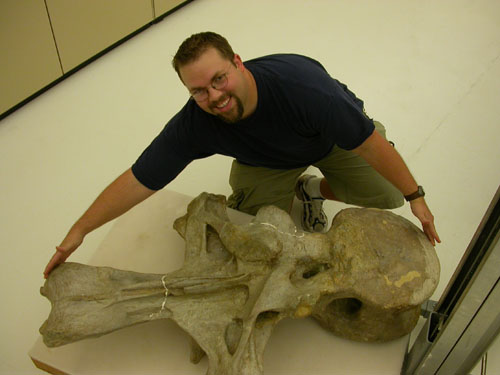
Jump forward to June 2004, when I went back to the OMNH with Andrew Lee, who snapped this cool shot of me with an immense dorsal vertebra of Apatosaurus. This is probably D5 or D6, based on the incipient cleft in the neural spine (the thing on the left that would be the neck and headboard if this was a guitar). It's an even 140 cm tall, compared to 105 cm for the same bone in the mounted skeleton of Apatosaurus in the Carnegie Museum. The Carnegie animal is about 70 feet long, so . . . you do the math.


Last summer I went to Chicago and spend a couple of days rocking the Field Museum with Mike Taylor. The highlight of the trip was getting to have our way with the holotype of Brachiosaurus for an afternoon. It came out of the ground about the same time the Wright brothers were taking off. This is the beast's humerus (upper arm bone). The top end is up by my head, and the elbow end is, well, missing. At least 8 inches, maybe a foot. So it should be even longer than it is. How much does that rock? I'll tell you: a lot.


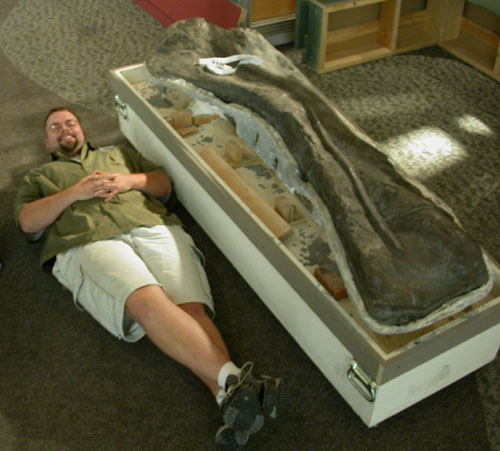
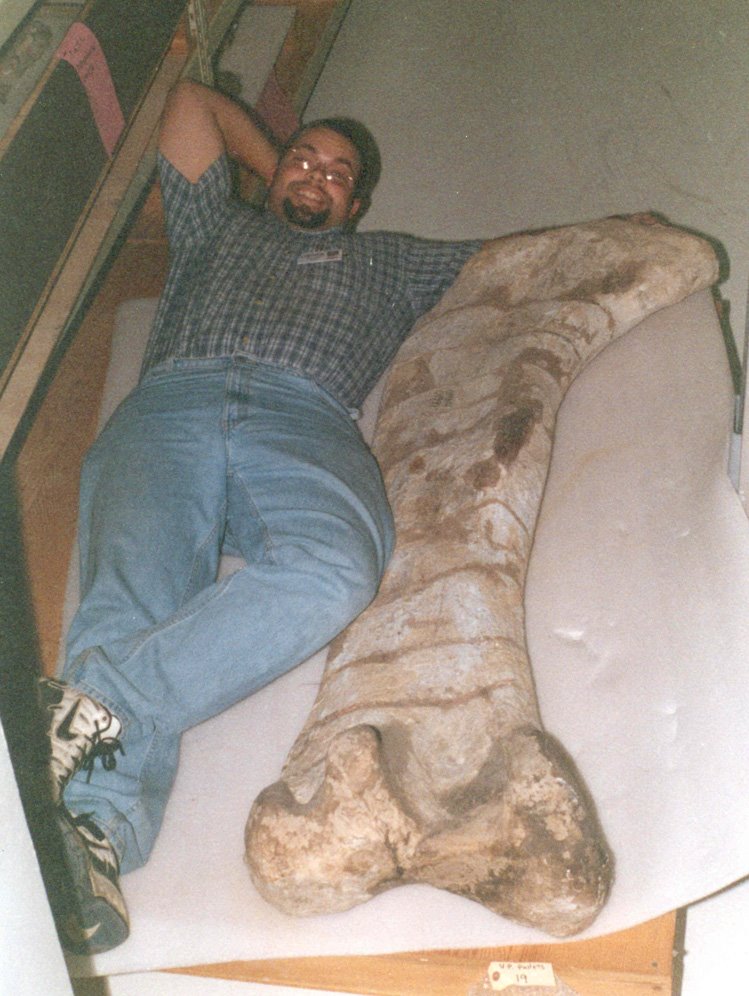
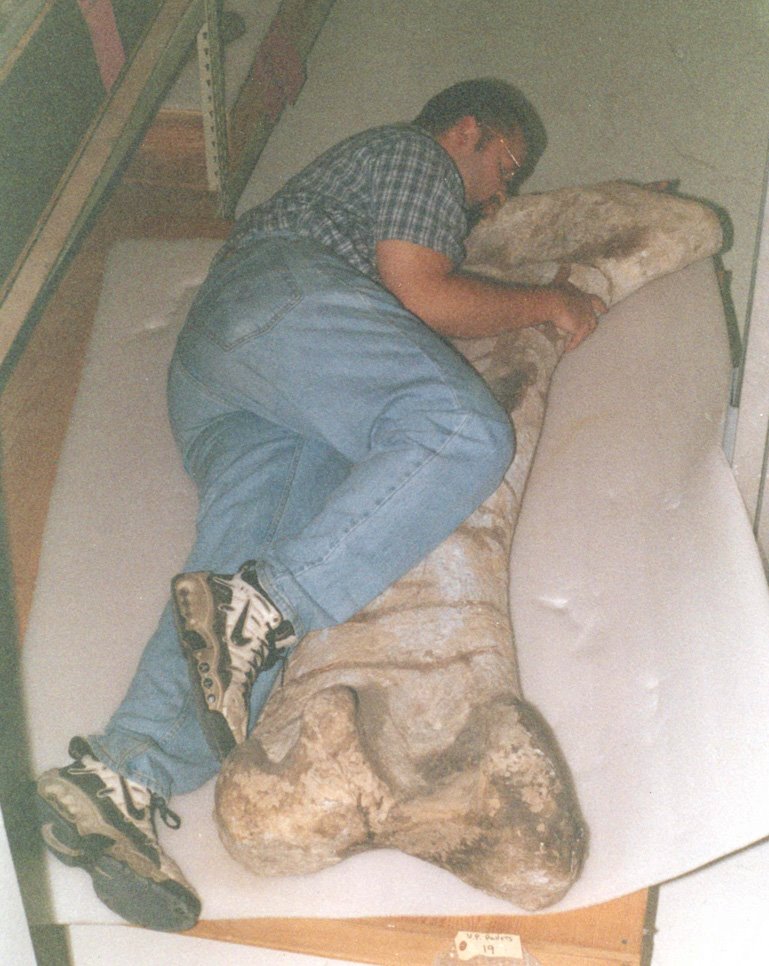
Time to break chronology. Back in 1999 or 2000 Matt Bonnan came to Norman and spent a few days crashing with Vicki and me and ransacking the OMNH collection. We eventually got a paper out of it, which is the second-best thing to come out of that visit. This is not the first-best thing, but it's close: me with an Apatosaurus femur. Just a normal-sized one; the femur from the monster whose backbone is shown above would be an even third larger.


Now this is the best thing from that visit.

Labels: , , ,