Friday, September 21, 2007

Lick Observatory trip, Part 1


Life is weird. One year when I was a kid we went to Colorado Springs on our family vacation. We went up to the top of Pike's Peak one day and went to the Cheyenne Mountain zoo the next. That was back in the late '80s . . . I hope there weren't any particularly important breeding programs at Cheyenne Mountain back then, considering it was sitting on top of NORAD and was (and might still be) the Zoo Most Likely To Be Turned Into Fallout.

Anyway, then we stayed a few days with some friends who lived in Colorado Springs. They'd lived there for years. Turned out that in all that time, they had never been up to the top of Pike's Peak. And the guy was a park ranger and his wife was a school teacher!

Which is worse, having something cool right on your doorstep and never checking it out, or having something cool on your doorstep and not even knowing it exists? I can't be too hard on those folks, because I've been in the UC system for six years and I never knew that the Lick Observatory (the first and AFAIK only entirely* UC-run observatory) even existed until a few weeks ago.

* UC is a managing partner on the Keck telescopes (schwing!) and has its fingers in a bunch of other astronomical badassery, including the upcoming Thirty-Meter Telescope, whose appellation rivals the Big Bang for sheer unironic literalness.


Lick Observatory is up on Mount Hamilton above San Jose. The photo below shows the view from the summit looking off to the northwest. The light-colored expanse in the upper left is the south end of San Francisco Bay. Lick was the first mountaintop observatory in the world. Up until it opened, all of the world's observatories were located in the same cities as the universities that ran them, or, if they were privately operated, at the operator's place in the countryside (like Herschel's 1.26-meter monster).


Last Saturday we took two dozen students from UCM up to Lick. It was fully awesome. They have seven domes up there, and six telescopes. The oldest dome was built in 1881; the newest was just completed and is currently waiting for the Automated Planet Finder, a robotic 2.4-meter reflector, to be installed.


The open dome in the photo above was completed in 1886 and houses the 36-inch refractor, which you saw a bit of in the teaser and about which you will see much more in an upcoming post. The dome on the right is at the other end of the building. That's the dome that was completed in 1881. For it's first century of operation it held a 12-inch refractor, but since 1979 it has held the Anna L. Nickel 1-meter reflector.


The view looking east. The shadow of Mount Hamilton is thrown onto the next range over by the setting sun. Which also brings and end to this post. Next up: the 3-m Shane reflector.

Labels: ,

Sunday, September 16, 2007

Lick Observatory teaser


Just got back from an all day field trip to the Lick Observatory on Mt. Hamilton above San Jose. Got the whole backstage tour, which culminated with my bloodshot, leering eyeball on the business end of a 36-inch refractor (that's 36 inches in diameter for you telescope n00bs). Tell you all about it later.

Hat tip to Darren for the concept of the teaser post.

Labels: ,

Sunday, January 21, 2007

Dr. Vector's field adventures


Hi folks, just some highlights from the Big Bend trip.


We spent most of our time looking for microfossils: teeth, scales, and scutes from fish, turtles, crocs, and dinos. The photo above shows (clockwise from left): my Swiss Army knife for scale, a little croc scute, a big gar scale, two halves of a dromaeosaur tooth that I found about a foot apart, and a big dead millipede. We found bleached-white millipedes and land snail shells all over the place.


We also did some big bone paleontology. Here I am jacketing a ceratopsian femur with Vanessa Meredith from Cal State Stanislaus. Everyone else on the crew was a current or former CSS person. Dr. Julia Sankey was in charge of the expedition. I was just along as a shovel jockey. It was a great vacation--hard on the body but great for the soul.


I spent a day with Bill and Mary Clark collecting desert ants. Bill is the director and curator of invertebrates at the Orma J. Smith Museum of Natural History in Caldwell, Idaho, and he's been surveying Big Bend ants for about seven years now. He is full of knowledge, generosity, and dry humor. Although I only got to spend a few days hanging out with him, he is one of my favorite human beings. I really hope I can go back to Big Bend next January, and if I do I hope to spend some more time chasing ants.

Now, for Darren's sake, some tetrapods.


These turkeys were always hanging around the campground. I don't know if people feed them or what, but they have very little fear of humans. You could walk up pretty close to them. If you got closer than 15 or 20 feet, they'd walk away until that invisible perimeter was reestablished, but they wouldn't flee. I'm sure they would have fled if we'd run at them waving our arms and screaming, but there's no reason to act like an asshole to a couple of agreeable critters who doubtless spend a lot more time in that campground than we do. We approached out of curiosity and admiration, not because we wanted to harrass some birds.


I spend the entire time wanting to see some javelinas, little peccaries (Tayassuidae) that are very common in Big Bend. We heard them rooting around at night and found their tracks and scat by day. Most everyone else on the crew saw a group (pack? peck?) of them down by the campground, but I think I was up at the ranchhouse cooking dinner at the time. I was getting a little desperate, but driving back from the quarry on the last day we surprised a big peck of paccaries crossing the road. Like idiots, we all bailed out of the van and ran into the bush trying to get photos of these diminutive but impressively beweaponed critters. We emerged unscathed, with photos ranging from completely incomprehensible to what I can only describe as "medium Bigfoot".


On the way back to California the next day, I got to kill some time in the Hip-O taxidermy shop in Alpine, Texas. I picked up a nice javelina skull on the cheap, and it will be gracing my wall very shortly. I'll put up some pictures as soon as I put up the skull; the photo above is stolen from Skulls Unlimited, which is currently having a sale on peccary skulls. You can see from the photo why pissing off a javelina is not smart: they have very large, very sharp canines, and they will use them. A gory warning poster at a Big Bend campground showed a domestic dog that had had one of its limbs ripped off by a javelina. Leash laws are there for a reason, folks.

Well, this post is threatening to become more about peccaries than about the desert (not that there's anything inherently wrong with that, I just have other things I want to do), so I'll wind it up with two last photos. The first one shows our breakfast and dinner table out behind the ranchhouse at Castolon. The cliffs in the distance are in Mexico; the Rio Grande flows at their base.

The last photo is my favorite from the trip. Gotta get back there.


Many thanks to Richard Peltier and Vanessa Meredith for sharing photos.

Labels: , , ,

Saturday, January 13, 2007

I'm back


...and a lot transpired while I was away, both around me and back here in the world. I'll blog about it when I catch my breath. In particular, there is the matter of Amphicoelias to deal with. But slumber calls. Catch you on the flip side.

Labels: ,

Monday, January 01, 2007

Later


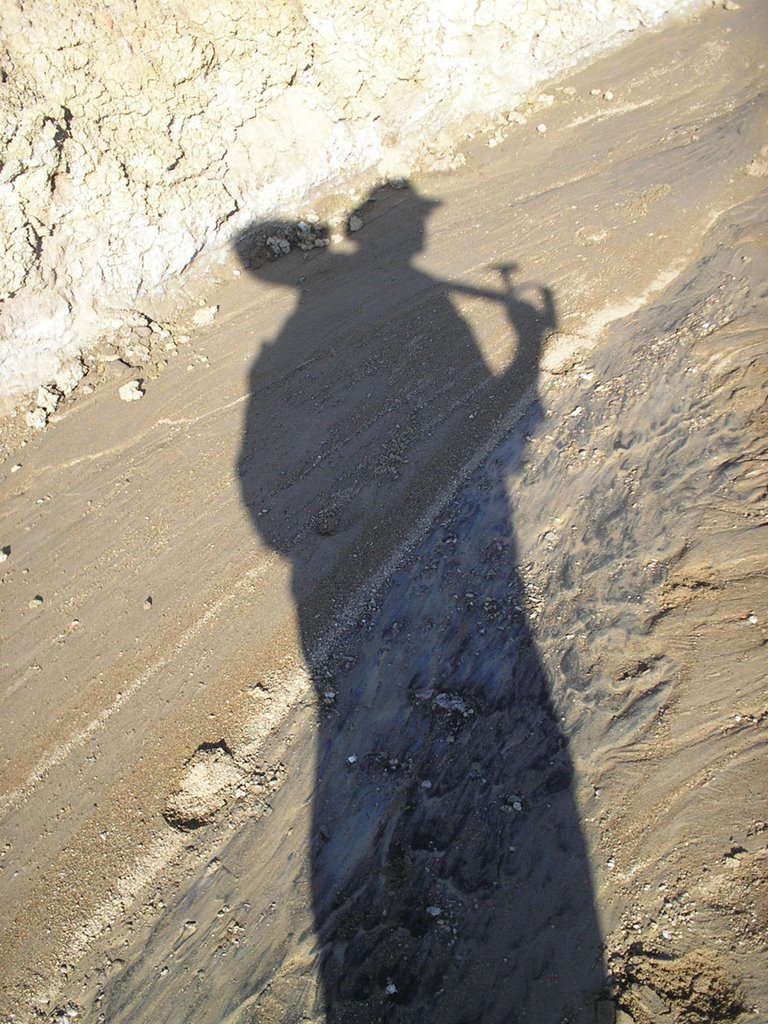
I'm off to the field. For the first time in, er, five and a half years. Yeah, I know, pathetic. I didn't even own a digital camera the last time I went out, and I haven't scanned in any old photos of me doing the field thang, so I'm recycling this oldie, which was at least taken on the way back from the field.

I'll be back to the world Jan. 12. See you then.

Labels: ,

Friday, September 29, 2006

Dr. Vector returns

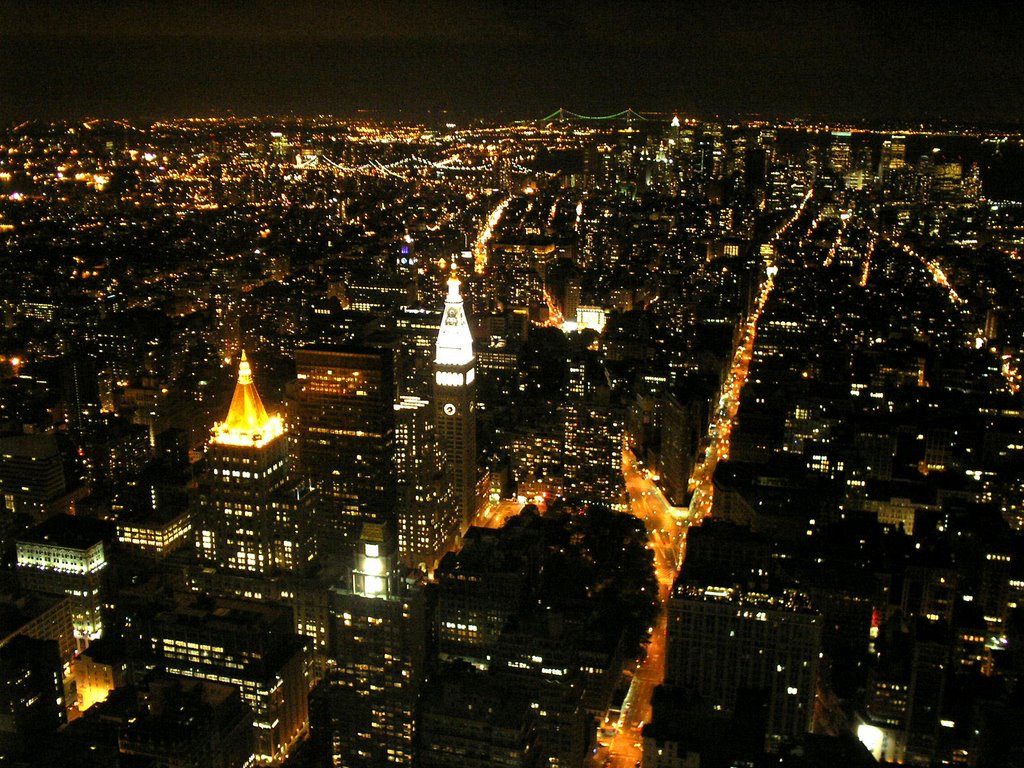
To blogging, that is. My physical body is still on the East Coast. And I'm only blogging to point you in the direction of my Flickr page, where I have posted some pix from the trip. Here are a couple of teasers, taken from underneath and on top of two of Manhattan's famous skyscrapers.


Labels: , ,

Monday, July 03, 2006

Old Navy Helo Pilot Strikes Back

Kent Lidke used to fly helicopters for the Navy in Antarctica, and he writes about it very well. This is one of the best things I've ever read. Even though he's writing about something very different from what I do, it's still a dream job, and it reminds me of how lucky I am to get to be a paleontologist.

This was originally an e-mail post in an online discussion about the future of space exploration. The previous poster had written something about real space travel being much less exciting than Star Wars and Star Trek. This was Kent's reply. Many thanks to him for giving me permission to post it.

------------------------

In all seriousness, this is true. Because of the flight times involved, flying between planets is not going to be exciting in our lifetimes. However, once you get there, the stuff you do CAN be exciting.

Like J-Rod and no doubt a lot of others, I wanted to be an astronaut when I was a kid, fly around the moon and all that. Even in college, I was studying aeronautical engineering and propulsion systems, and checking out payload integration companies like Orbital Sciences. I graduated 5 months after the Challenger explosion and space was drying up, so I joined the Navy thinking I could go the test pilot route, and maybe things would be hot again by the time I got through that. Then I ended up in helicopters, which turned out to be a good thing, and then I got insanely lucky and got a slot with the Antarctic program.

I can tell you what it's going to be like 25 or 50 or a hundred years down the road when they're exploring the moon and Mars, because that's what Antarctica was like. It was exactly like what everyone wants space exploration to be like. No giant mission control room, no eight years of training and waiting for your ride. You go down to the hangar in the morning, get your list of science missions, preflight your ship, and off you go.

You spend the day landing your ship in places no human being has ever been, you see things too big to capture in a picture, you wear lots of cool gear and a helmet with a visor, you get to camp out on an alien surface every once in a while. The scientists tell you about what they're doing, and what it means, and why they love it. You visit other stations, trade patches, try their food, and drink their wine. You climb mountains in 80 knot winds and get so cold you can't talk so you have to use hand signals, you get scared shitless by warning lights, wind shears and low fuel warnings. You break down and have to lash your busted ship together with duct tape and bailing wire, and nurse it back to the base.

You don't get TV or phone calls, you make do with an occasional HF radio patch, if the solar activity isn't frying the ionosphere, and sometimes you can pick up a relay of the super bowl on the navigation radio. You wait for the next supply run from home with fresh vegetables and mail, and you have big parties for everyone at the station for Halloween, Christmas and New Years. Anyone who can play an instrument gets together for a concert and barbecue in the spring.

You work hard and you play hard, because every day really can be your last. Risk really is your business, and it's cool and exciting and scary and 100% totally kickass. You have never been so alive before and you never will be again, and you know it. When you leave for the last time, it breaks your heart, and you spend the next ten years wishing things could have stayed that way forever.

That's what it's supposed be like, and that's what it IS like, once you get there. It'll be that way on the moon, it'll be that way on Mars. It'll be full environment suits instead of cold weather gear, it'll be lumbering interplanetary transports instead of C-130s, and I don't know what they'll use for Hueys but there'll be something. There will be pilots and mechanics and cargo handlers and radio operators, scientists and lab techs and administrators, and survival specialists and firemen and kitchen workers and construction workers and shuttle bus drivers.

Ordinary people who aren't rocket scientists will live and work there because they got an itch to do something extraordinary. Every once in a while they'll get a chance to take a ride out of town and see something, and they'll show up at the hanger all wound up like little kids, and they'll take their cameras and video recorders and get on the ship and for a few hours they'll get to see and do things most of the human race only dreams about, and they will live lifetimes in those hours, and they will treasure every single minute of it.

I got incredibly lucky. I stumbled into a real life frontier right here on Earth, an exploration program that was all about the science and the learning and the knowing, and it turned out to be everything I was looking for in a place I never would have thought of. National Science Foundation, civilians, Navy, Army, American, Kiwi, Aussie and every other kind... It was real life Star Trek, all people working together for the benefit of all mankind.

So go ahead and say it's not real. For most of the world it never will be. But for those with the dream, and the drive and the luck, it's going to happen. I've seen it, and it fucking rocks.

Labels: , , ,

Thursday, May 25, 2006

Warning: Old Navy Helo Pilot story ahead...

Tragically, it's not mine. One of Jarrod's animator homies, Kent Lidke, used to fly helicopters for the Navy. In Antarctica. It is one of those jobs that is actually even more badass than it sounds, as Kent's stories attest. This one's a gem. Many thanks to Kent for letting me post it. I'll pester him for more.

---------------------------------

Warning: Old Navy Helo Pilot story ahead...

Back in the day, we flew some GPS surveyor guys from the New Zealand Geological Survey up to some unknown peak down on the ice. 60 kt winds, gusting to 80, the friggin' helo wanted to lift off at idle. They needed something like 45 minutes to an hour to get the precision they were looking for, so we shut down, and they climbed up the last 50 or a hundred yards to the top of the peak to set up their gear. After about an hour and 15 minutes, I finally decided I better go see what was up, so I pulled on my Korean War surplus Arctic parka over all the stuff I was already wearing, goggled up and climbed out. The wind would've just about blown me off the mountain, so I more or less crawled up to where they were. By the time I got there, my face was so frozen I couldn't talk clearly, so I had to gesture at my wrist and shrug in order to say "How much longer?" They said they needed about 15 more minutes, so I crawled back down to about 50 feet from the bird and curled up in the lee side of a rock to smoke a cigarette, more for the challenge and to kill time than anything else. The zippo lighter, contrary to claims, will not light in all circumstances, but the survival matches did the trick, and I sat on the side of a mountain in Antarctica no one had ever walked on before, smoking a cigarette in an 80 knot wind.

Anyway, after a while the guys crawled down from the peak and we all climbed into the helo. According the airspeed indicator, winds were still 60 to 80 kts. The book says the wind limits for starting up are 45 kts. Fortunately, in a completely unrelated chapter, the book also says the airspeed indicator is unreliable below 70 knots, so we decided it was fair to say that we didn't KNOW the winds were over 45, and hit the starter. Well, the damn thing was so cold soaked that the first engine wouldn't start, but the starter motor already had the rotors turning a little and if we didn't spin them up quick the wind would probably flap them right into the tailboom, so we flipped the starter over to the other engine hoping the battery wasn't dead yet. That engine lit, but hung up and didn't make it all the way to idle speed because half the fuel manifold was frozen shut. I opened the throttle wider, hoping if I let it run for a couple minutes the fuel lines would thaw out, and that when they did the sudden fuel surge wouldn't blow the engine up. Sure enough, after a couple a minutes there was a whump of compressor stall and a whine as the engine tried to overspeed, but we caught it with the throttle. After that getting the second engine started was easy, and all we had to do was manage to take off in a blizzicane.

We lifted off with the stick shoved almost all the way forward and still ended up backing out of the lz, and once we had a little room pulled the stick back to center. It was like popping a big parachute, 0 to 80 in no seconds with a right roll to get turned around in the direction we were going and diving down the mountain like Franz Klammer to try to pick up some airspeed to go with our ground speed. It seemed totally insane but it worked like a charm.

I would do that every day of the week and twice on Sunday if I could. That was a great f'ing day.

I would sincerely like to thank you all for paying me to do stuff like that.

-----------------------------

See ya. I'm off to be a helicopter pilot in Antartica. *Sigh*

In lieu of going to fly a helicopter myself, I will seriously bug Kent to let me put up his awesome post on how flying a helicopter in Antarctica is like being a real-life space explorer. It's possibly the most badass thing I've ever read. Stay tuned, true believers.

Labels: , ,

Wednesday, May 17, 2006

The big'un


The other whale at the Long Marine Lab is a Blue (Balaenoptera musculus). It's an 87-footer. The longest known Blue Whale was 110 feet long, so despite its size, the one shown here is only 4/5 the size of the biggest individuals.

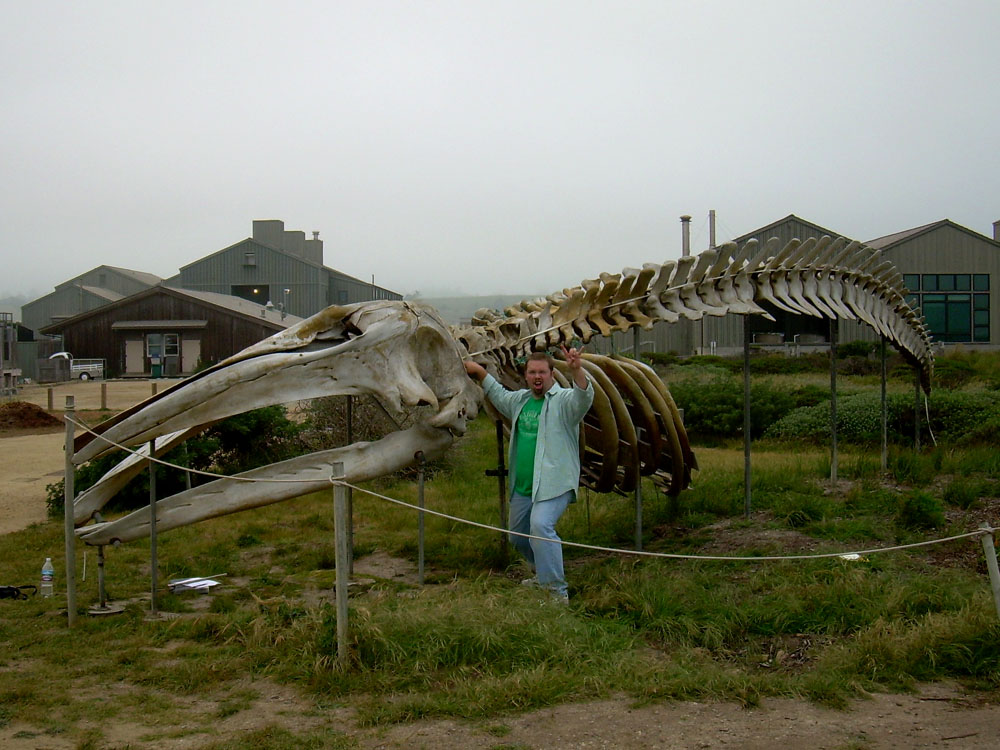
Here, at last, is something to stun even a sauropod worker. Check out this picture of Nick standing inside its jaws, and compare to the similar shot with the Gray Whale in the previous post. The Gray Whale could pass through the jaws of the Blue and not even scrape the sides.

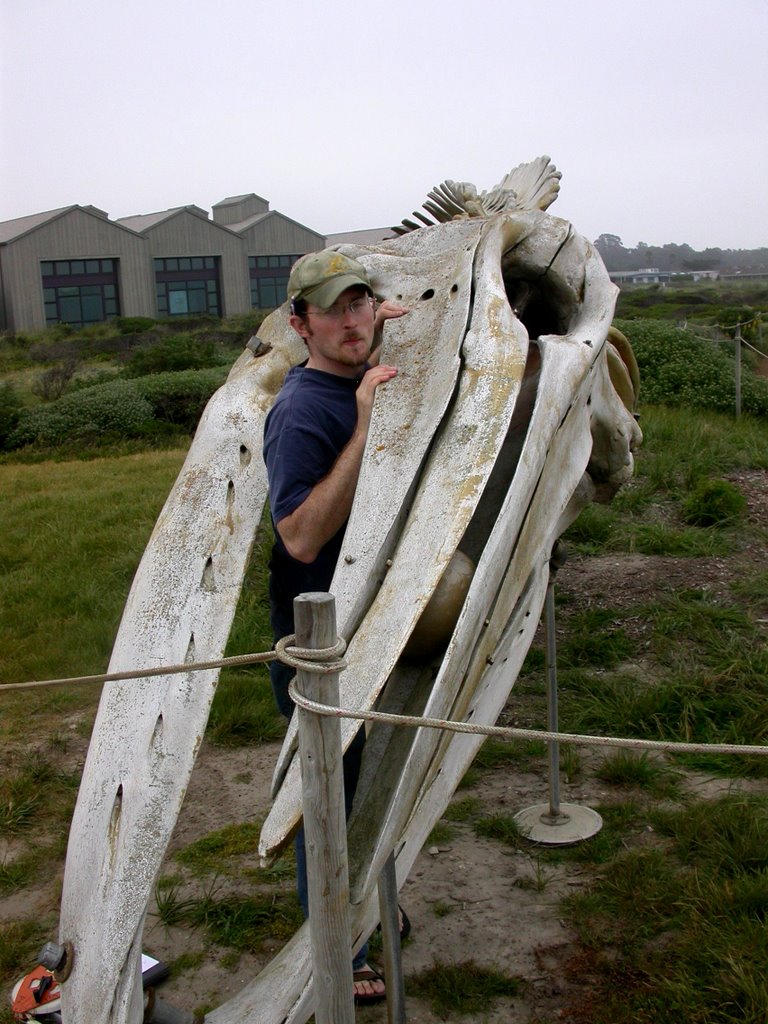
Nick gave me an interesting perspective on how these big whales feed. They're not really filter feeders. A true filter feeder is something like a Basking Shark that just swims around with its mouth open and strains out whatever comes through. The big baleen whales pick their targets and engulf them with their giant jaws and extensible mouth/throat region. They are often feeding on swarms of krill that measure kilometers in extent. Rather than think of big whales as filter feeders, we should think of them as predators that take bites off of superorganisms that are hundreds of times larger. The fact that the krill are strained out of the water by the baleen is a matter of processing--it comes after the whale has taken a bite. Here Nick is measuring the mandibles, as part of a study on this very subject.

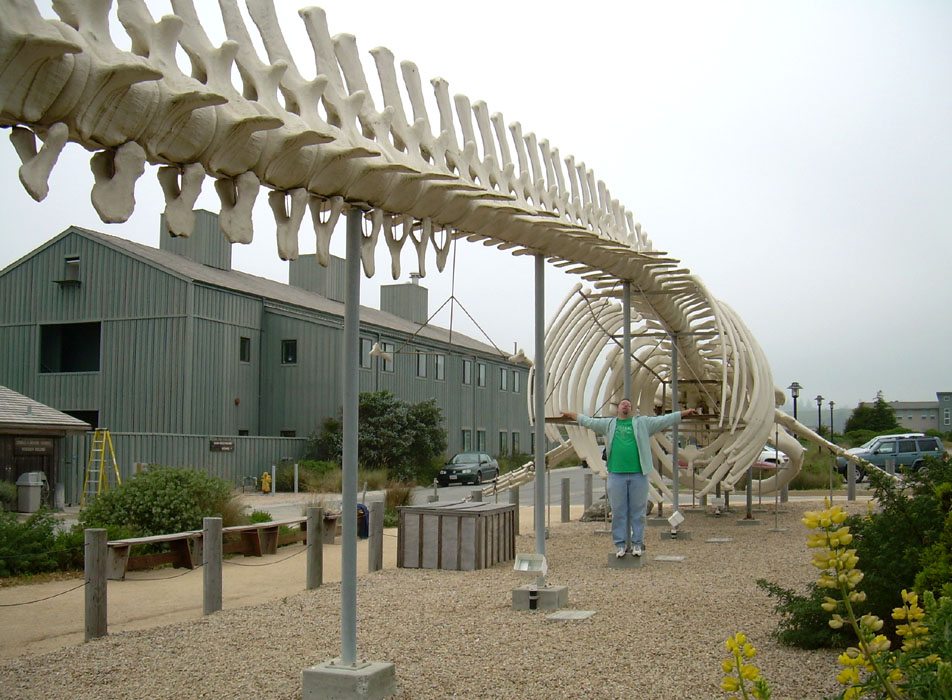
The size of the rib cage is staggering. As Nick pointed out in a recent joint talk that we gave at Berkeley, a 100-foot Blue Whale is approximately the same size as a Boeing 737, in both length and girth. So the next time you're on a 737 or equivalent, have a look around--you could be in the belly of a whale.

This one isn't that big, but still large enough to fit me inside with lots of room to spare. It is worth recalling that Elmer Riggs named the type species of Brachiosaurus altithorax in reference to a seven-foot rib, which was at that time the longest of any known sauropod. We didn't measure any of the ribs, but they're a darn sight longer than seven feet.

If you ever have the chance to go whale-watching, do it. I've been three times, all of them trips from Monterey into Monterey Bay. I've been fortunate in that I've seen new and bigger whales every time I've gone out. The first time we tailed a pod of half a dozen Gray Whales. It was just mind-blowing how big they were. Despite my derrogation of the Gray in the previous post, it is one thing to stand next to a skeleton and another thing entirely to see the animal in the flesh. It's a feeling that I always get when I'm around horses. They are just huge animals, way outside the human scale in terms of mass and strength. Multiply that by a thousand or so and you will know what it's like to see a Gray Whale in the flesh.

The second time I went out, we followed a momma Humpback Whale and her calf, which was about 2/3 grown. The Humpback was significantly larger than the Grays. But it didn't hold a candle to the Blue Whale that I saw the most recent time. From seeing the Grays and the Humpbacks, I had a feeling for how long it takes a whale to 'roll over' when it comes up and then goes back down. The Blue Whale blasted my expectation. It was almost stomach-turningly immense. After it spouted it would nose down and its back would break the surface in a long curve as it headed back down. But the back just kept coming, more and more whale emerging from the water until your mind rebelled: No living thing could possibly be that big. And yet it is.

These experiences have only sharpened my hopeless desire to see a sauropod in the flesh. What have saurichians come to?

Labels: , , ,

Finally, a real live whole dead whale


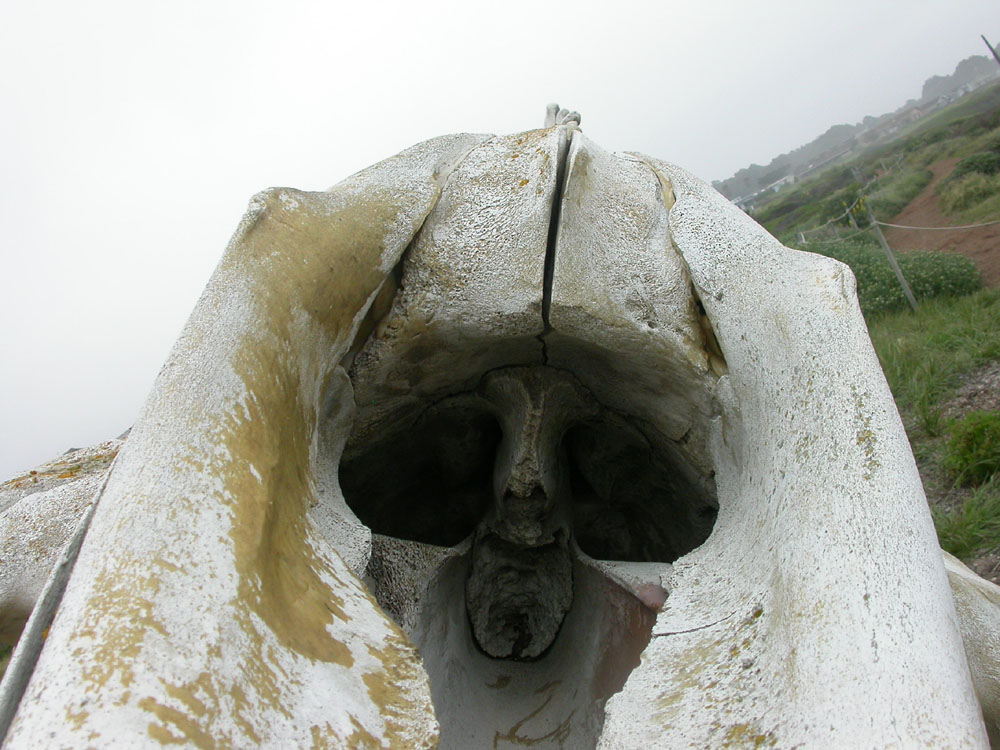
The Long Marine Lab here in Santa Cruz has a couple of whale skeletons mounted outdoors, and Nick got permission for us to measure them. I'll start with the pathetically tiny one, a Gray Whale (Eschrichtius robustus, foo'). By "pathetically tiny" I mean a shade over nine meters long and probably not massing more than 10 tons (incidentally, 10 tons is Mike Taylor's threshold for considering something interesting). Some other things that are nine meters long are the Supermarine Spitfire and the neck of a good-sized (but not record-sized) Brachiosaurus. Gray Whales get up to about 15 meters long and about 35 tons, or so Wikipedia tells me. That's a little longer than a big T. rex--"Sue" is only 12.5 meters--and probably about as heavy as a good-sized Brachiosaurus, like the mounted skeletons in Berlin and Chicago.


Whoops, sorry, I'm trying to resist the siren song of sauropods for a few posts here, but it ain't easy. A-ny-way, the Gray Whale skeleton at Long Marine Lab is still under construction. It's mounted at an oblique angle because Gray Whales use their baleen to strain small crustaceans out of the sand and muck at the bottom of the ocean, and they turn on their sides to do it. Like almost everything under the sun, the whales show "handedness" and tend to preferentially feed on one side (other examples that I know of include elephants, crocodiles, and turtles--how has Darren not blogged about this yet?). The skeleton hasn't been weatherproofed yet, but hopefully it will be soon.

Anyway, I hope you can look past the animal's extremely small size and find something of interest in the pictures. This next picture is kinda cool on its own, but it will be a lot cooler after I get the next batch posted, so you'll have something truly impressive to compare it to.


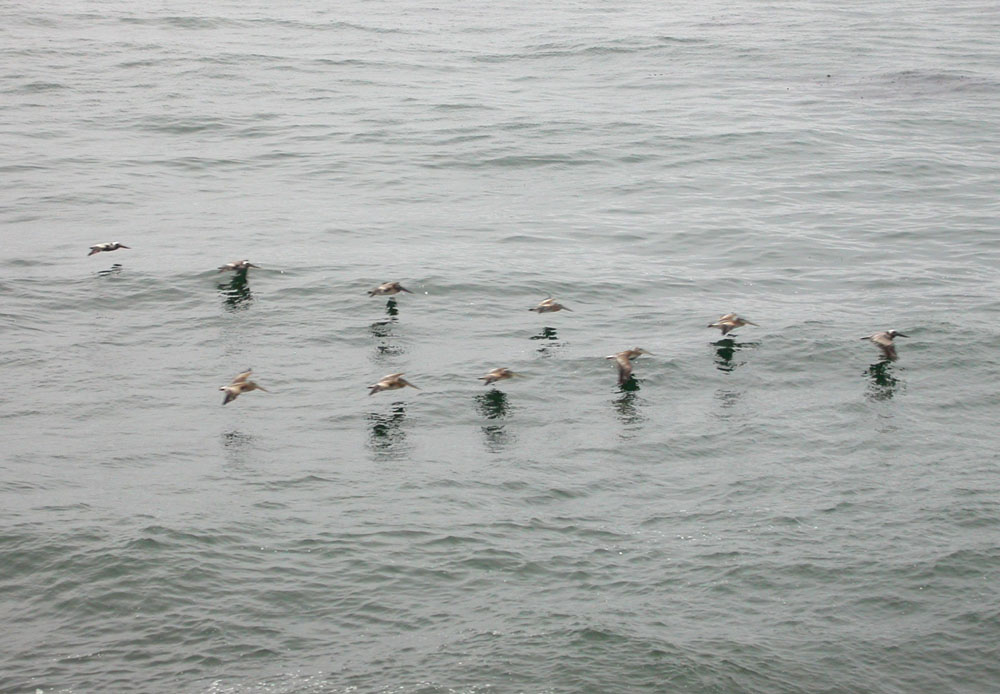
As we were working, flights of pelicans kept zooming past, on their way who knows whither.

Stay tuned for the mother of all sea monsters. For real this time, not like my crab confusion episode.

Labels: , ,

Tuesday, May 16, 2006

More from New Brighton

More photographic booty from the New Brighton beach walk.


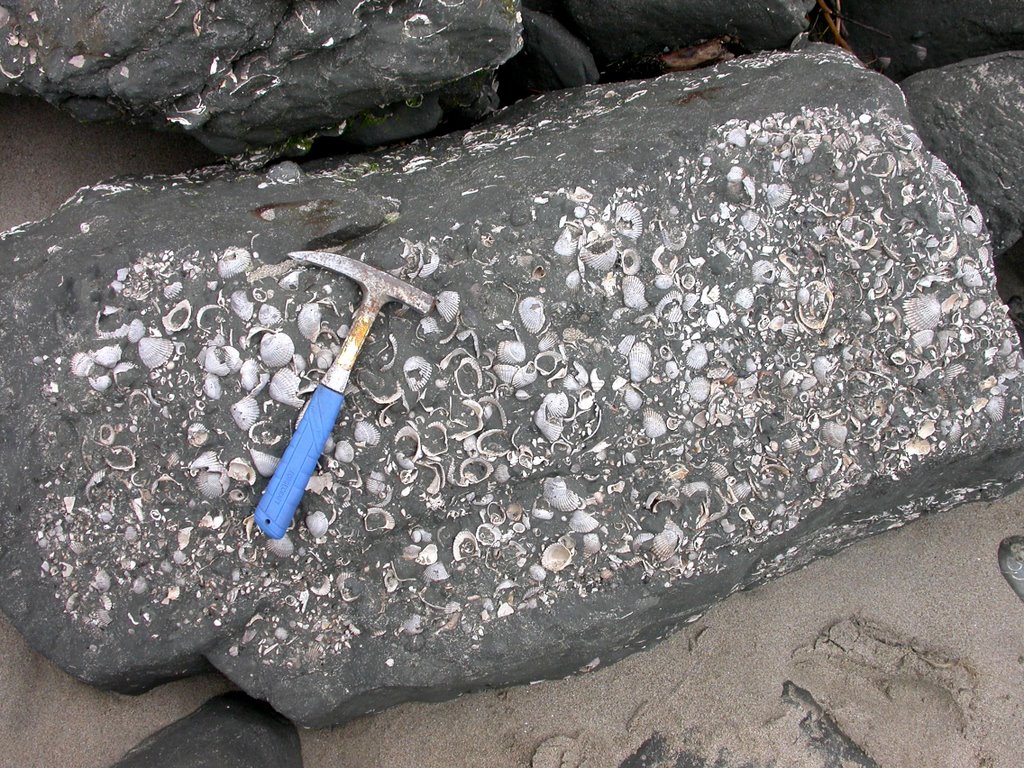
A shell bed from the top...


...and from below.


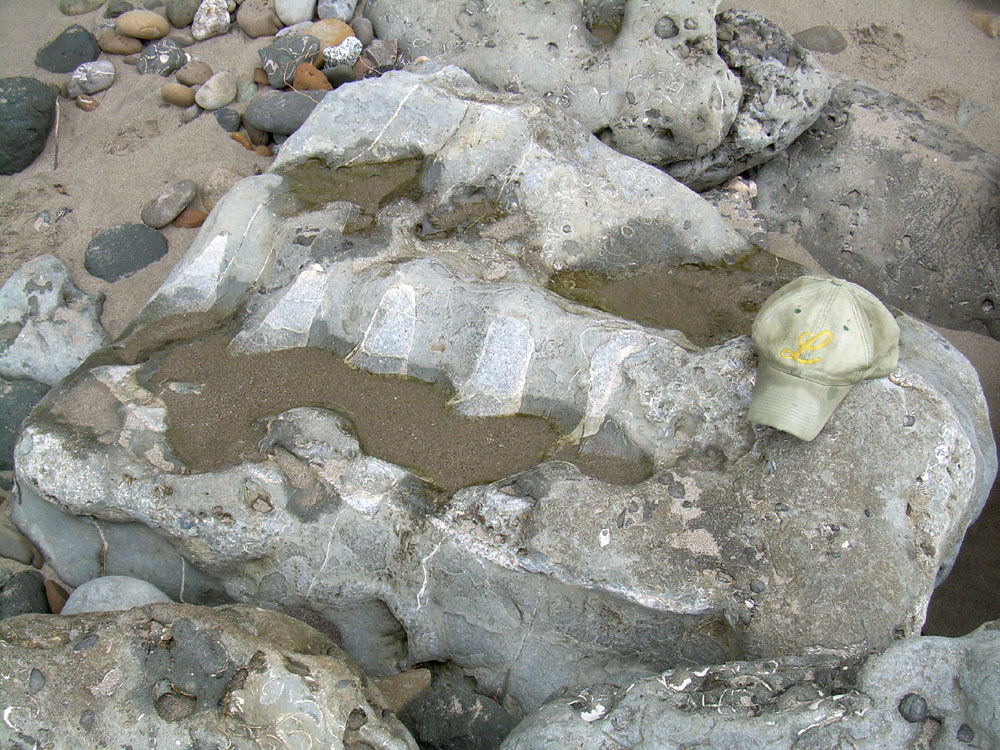
The biggest chunk of whale we found was this table-sized block with some ribs. That's Nick's hat for scale. The L stands for 'luscious'.

Now, seriously, there will be some respectable whales up next.

Labels:

Miocene clams

No, really.

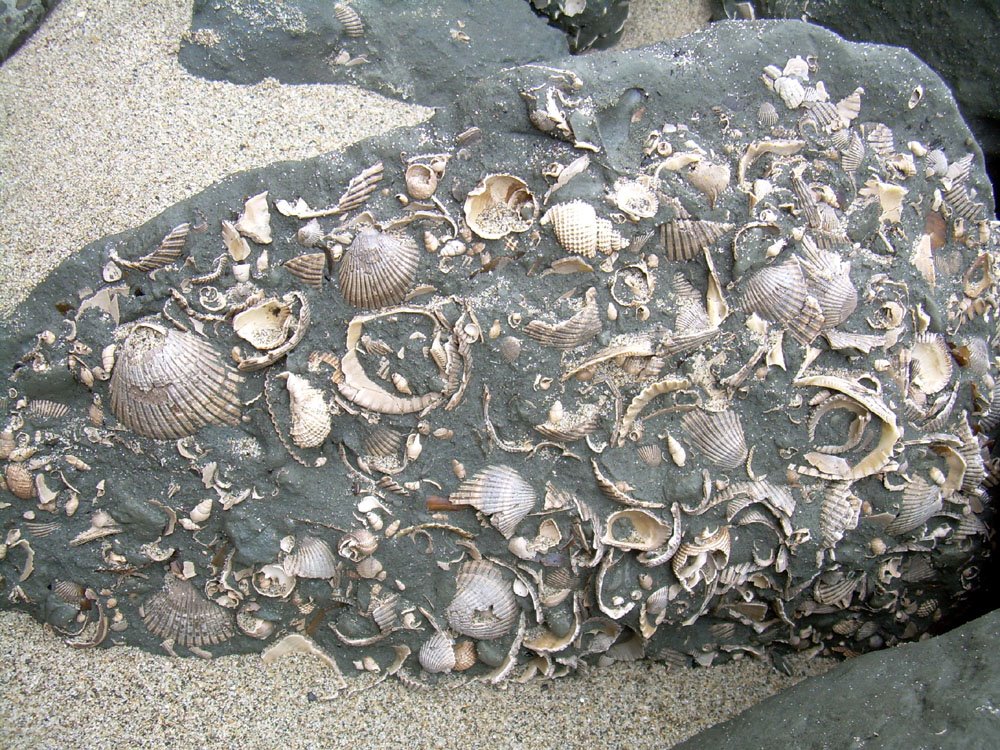
Nick Pyenson came down to Santa Cruz yesterday for some paleo and marine biology action. We met Kena Fox-Dobbs* and Patrick Wheatley of the Koch lab at New Brighton state beach in Capitola to walk the cliffs and see if anything interesting was exposed. The whole coast here is Miocene Purissima Formation, and there are definitely fossil whales in there. But mostly, there are bivalves. Herewith, some photos.

*If the name sounds familiar, you may be thinking of her work on condor diets (see, e.g., Chamberlain et al. 2005).


The Purissima in all its shelly glory.


Summa dem shells.


Here's what a fault looks like. With Kena (l) and Nick (r) for scale.


And here's what a fault does to fossils. The technical term is "hamburgerization".

Stay tuned for photos of Nick and me playing with whales.

REFERENCES

Chamberlain, C.P., J.R. Waldbauer, K. Fox-Dobbs, S.D. Newsome, P.L. Koch, D.R. Smith, M.E. Church, S.D. Chamberlain, K.J. Sorenson, and R. Risebrough. 2005. Pleistocene to recent dietary shifts in California condors. Proceedings of the National Academy of Sciences, USA 102(46):16707-11.

Labels:

Tuesday, May 09, 2006

The umbrella effect as applied to marine mammals

You know the umbrella effect: if you carry an umbrella, it may not rain, but if you don't, it's sure to. Same deal with taking a book when I hop in the car to go literally anywhere; about 95% of the time I don't need it, but any situation in which you're stuck for an hour or two and wish you had a book is by definition unforeseeable, so it's better to have a book along just in case.

Yesterday afternoon we went for a long walk along West Cliff. I almost grabbed my binoculars as we headed out the door. I consciously thought, "Hey, maybe I should take my binoculars." And then my stupid brain said, "Nah!"

Stupid, stupid brain.

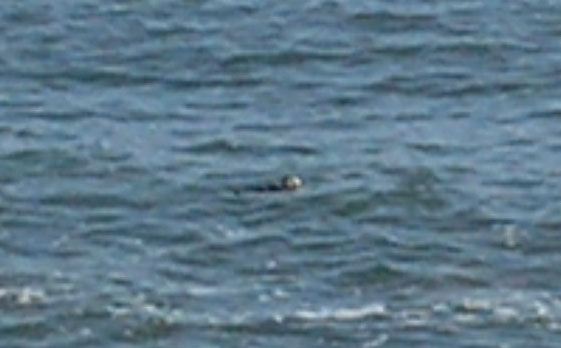
Within five minutes of getting out of the car, we saw a pair of sea otters frollicking amongst the kelp. Just far enough out that some binoculars would have been great. Oh, and there was one rock a ways out where some sea lions were having a lay in the sun convention. And then on the way back we saw dolphins. I've never seen dolphins from shore at West Cliff. Finally, as we came around to Lighthouse Point there was another sea otter just about 50 yards from shore. Fortunately, I had a digital camera; unfortunately, it was the lo-rez POS we got for taking pictures of London. Here's my strikingly Nessie-esque photo of the alleged sea otter; you'd be forgiven if you thought it was a dead mime, or a really big bird dookie.


One of these days I'm going to get some of those binoculars with the digital camera built in, and I'm going to wear them everywhere. I don't care how stupid it looks. We can talk about stupid after I get ultrarich from selling my photos of Sasquatch and UFOs. I'll be that one guy who really did have binoculars and a camera ready when that once-in-a-lifetime event happened.

Yeah!

Oh, there were also shitloads of cormorants and pelicans, as always. Hardly worth mentioning. I'm just piling on the tetrapods to hopefully make Darren jealous.

Labels: , , ,