What matters now, Part 1: coursework
Does coursework matter?
Let me be clear about that. When you start out you don't know anything, and courses are one time-honored way of learning stuff. Some stuff is really dense and technical, and there is really no way to learn it besides being involved with a course (either taking the course, or teaching it). Human anatomy comes to mind. Looking at pictures in a book or on a computer is not a substitute for dissection, and the circumstances under which you can cut up someone else's mortal remains are tightly (and rightly) controlled by the state. So if you want to learn human anatomy, a course is pretty much your only option.
But what about comparative vertebrate anatomy? You need dead animals to cut up, and you need some kind of reference material--textbooks, dissection guides, or possibly [preferably?] primary descriptive literature. Some folks with similar interests to learn with and help out with logistics will certainly help. A good course in CVA can supply all these things, but you can get them without a course.
Animals can be had from the grocery store or from nature, depending on your proclivities and local statutes. Back in Oklahoma a fishing license covered the reasonable collection of all nonmammalian and nonavian nonendangered vertebrates, and a hunting license covered the rest (mammals and birds, that is, not endangered species). So for an outlay of about $30-40 you could legally collect just about anything. Dissection manuals are a dime a dozen if you live in a college town; if you don't you can still get them through the local library. Helpers are ideally the people you drink beer with. All of these things are available to the average citizen for minimal money and effort. Some legendary anatomists got to be legendary without ever having any formal training at all. So in CVA a course can be helpful, but it's not a dealbreaker.
What about phylogenetics? I took phylogenetics here at Berkeley from David Lindberg and Brent Mishler, and I learned a ton. But most of what I learned was history and theory. Most of what I know about the practical aspects of building and using cladograms I learned on my own. Cladistics as a discipline has grown up out in the open. Almost all the literature you need is recent and easy to get your hands on, and the people writing the papers are the same ones writing the programs. And many good programs are freeware. I don't know, but I suspect, that many students that are producing cladograms or doing phylogenetically-based analyses (character correlation using independent contrasts, for example) have never had a course in phylogenetics. In that respect learning phylogenetics is probably similar to learning Photoshop: learn as you go. Undoubtedly, I am a better biologist for having had the phylogenetics course, but a quick survey of the field should convince you that a lot of folks are getting along without one, and most of the stuff I actually use I picked up on my own.
(Quick confession: I have published cladograms, but they were not generated with software; I have generated cladograms with software, but not published them; and I have done a lot of character analyses but those aren't published yet.)
What about, say, descriptive morphology? I suppose it's not beyond the bounds of possibility that a course in this might exist somewhere, but I've never heard of one. I think Aristotle said something like, "The things you can't learn by being taught, you learn by doing." That's a pretty fair description of doing descriptive morphology. Nobody can really tell you how to describe that sauropod vertebra without describing it. It certainly helps to read a lot of descriptions to figure out how to organize your writing and to see what makes for good and bad description, but as far as I know everyone who is in the business of describing stuff learned by doing. Here's a really intricate and important job for which courses don't even exist.
What I've tried, with these examples, is to build a spectrum of coursework importance that goes from crucial through helpful to nonexistent. I skipped irrelevant, but it would be easy to come up with an example. My undergrad journalism(!) course on Star Trek and Star Wars comes to mind. It did not make me a better journalist, nor did it substantially improve my knowledge or appreciation of ST and SW. It was just a fun way to pick up three credit hours.
The reason this is on my mind is that the other day I had a serious conversation with a friend about the state of paleontological training at Berkeley. If you go here you can find a very impressive list of courses that ostensibly form the buffet of educational excellence here. What you won't learn from the list is that many of those courses are offered very infrequently. Some haven't been offered in years. We don't even have a paleobotanist around to teach paleobotany, for example. In my friend's view, the erosion of course offerings in paleontology is a serious threat to Berkeley's continued status as a paleontological powerhouse.
I wondered then, and am wondering out loud now, if that is true. Is coursework relevant? I'm not a paleobotanist. A paleobotany course would certainly patch some holes in my knowledge, but those holes aren't in the areas in which I work. Would knowing paleobotany help me be a better dinosaur anatomist? Possibly, but I doubt it. It seems to me that most of the stuff that I use in my work came from the "learn by doing" end of the spectrum. I think that my coursework has been adequate, but in looking at what makes me the fine specimen I am today coursework has been far less important than informal experimentation, either by myself or with interested friends.
On the other hand, of course I would think coursework is irrelevant, because I've had so little of it. Possibly my self-assessment is way off base. Maybe more coursework would have made me a substantially better paleontologist.
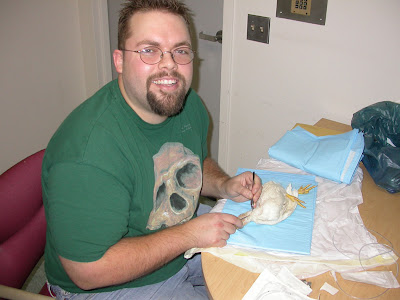
But I doubt it.
What do you think? (I'm mainly interested in what you think about the importance of coursework, not whether I rock or suck. But hey, it's your comment field, do what you like.)
Let me be clear about that. When you start out you don't know anything, and courses are one time-honored way of learning stuff. Some stuff is really dense and technical, and there is really no way to learn it besides being involved with a course (either taking the course, or teaching it). Human anatomy comes to mind. Looking at pictures in a book or on a computer is not a substitute for dissection, and the circumstances under which you can cut up someone else's mortal remains are tightly (and rightly) controlled by the state. So if you want to learn human anatomy, a course is pretty much your only option.
But what about comparative vertebrate anatomy? You need dead animals to cut up, and you need some kind of reference material--textbooks, dissection guides, or possibly [preferably?] primary descriptive literature. Some folks with similar interests to learn with and help out with logistics will certainly help. A good course in CVA can supply all these things, but you can get them without a course.
Animals can be had from the grocery store or from nature, depending on your proclivities and local statutes. Back in Oklahoma a fishing license covered the reasonable collection of all nonmammalian and nonavian nonendangered vertebrates, and a hunting license covered the rest (mammals and birds, that is, not endangered species). So for an outlay of about $30-40 you could legally collect just about anything. Dissection manuals are a dime a dozen if you live in a college town; if you don't you can still get them through the local library. Helpers are ideally the people you drink beer with. All of these things are available to the average citizen for minimal money and effort. Some legendary anatomists got to be legendary without ever having any formal training at all. So in CVA a course can be helpful, but it's not a dealbreaker.
What about phylogenetics? I took phylogenetics here at Berkeley from David Lindberg and Brent Mishler, and I learned a ton. But most of what I learned was history and theory. Most of what I know about the practical aspects of building and using cladograms I learned on my own. Cladistics as a discipline has grown up out in the open. Almost all the literature you need is recent and easy to get your hands on, and the people writing the papers are the same ones writing the programs. And many good programs are freeware. I don't know, but I suspect, that many students that are producing cladograms or doing phylogenetically-based analyses (character correlation using independent contrasts, for example) have never had a course in phylogenetics. In that respect learning phylogenetics is probably similar to learning Photoshop: learn as you go. Undoubtedly, I am a better biologist for having had the phylogenetics course, but a quick survey of the field should convince you that a lot of folks are getting along without one, and most of the stuff I actually use I picked up on my own.
(Quick confession: I have published cladograms, but they were not generated with software; I have generated cladograms with software, but not published them; and I have done a lot of character analyses but those aren't published yet.)
What about, say, descriptive morphology? I suppose it's not beyond the bounds of possibility that a course in this might exist somewhere, but I've never heard of one. I think Aristotle said something like, "The things you can't learn by being taught, you learn by doing." That's a pretty fair description of doing descriptive morphology. Nobody can really tell you how to describe that sauropod vertebra without describing it. It certainly helps to read a lot of descriptions to figure out how to organize your writing and to see what makes for good and bad description, but as far as I know everyone who is in the business of describing stuff learned by doing. Here's a really intricate and important job for which courses don't even exist.
What I've tried, with these examples, is to build a spectrum of coursework importance that goes from crucial through helpful to nonexistent. I skipped irrelevant, but it would be easy to come up with an example. My undergrad journalism(!) course on Star Trek and Star Wars comes to mind. It did not make me a better journalist, nor did it substantially improve my knowledge or appreciation of ST and SW. It was just a fun way to pick up three credit hours.
The reason this is on my mind is that the other day I had a serious conversation with a friend about the state of paleontological training at Berkeley. If you go here you can find a very impressive list of courses that ostensibly form the buffet of educational excellence here. What you won't learn from the list is that many of those courses are offered very infrequently. Some haven't been offered in years. We don't even have a paleobotanist around to teach paleobotany, for example. In my friend's view, the erosion of course offerings in paleontology is a serious threat to Berkeley's continued status as a paleontological powerhouse.
I wondered then, and am wondering out loud now, if that is true. Is coursework relevant? I'm not a paleobotanist. A paleobotany course would certainly patch some holes in my knowledge, but those holes aren't in the areas in which I work. Would knowing paleobotany help me be a better dinosaur anatomist? Possibly, but I doubt it. It seems to me that most of the stuff that I use in my work came from the "learn by doing" end of the spectrum. I think that my coursework has been adequate, but in looking at what makes me the fine specimen I am today coursework has been far less important than informal experimentation, either by myself or with interested friends.
On the other hand, of course I would think coursework is irrelevant, because I've had so little of it. Possibly my self-assessment is way off base. Maybe more coursework would have made me a substantially better paleontologist.

But I doubt it.
What do you think? (I'm mainly interested in what you think about the importance of coursework, not whether I rock or suck. But hey, it's your comment field, do what you like.)
posted by Dr. Vector at 9:36 PM
9 comments